Satisfaction, according to neuro-scientist Gregory Berns, is not the same as happiness. Satisfaction is the feeling you get when you engage in a challenging and novel experience. Happiness is what you feel when something good happens to you, like winning the lottery. Satisfaction is active; happiness is passive. In his book Satisfaction: The Science of Finding True Fulfillment, Berns says that the pursuit of satisfaction is about personal growth and learning something new.
Aha, so that explains the “challenge binge” I’ve gone on in the last month or so. The timing is not coincidental. I’m about to type “The End” to the first draft of my romantic suspense novel. Yes, that’s a good feeling but there’s lots of polishing to be done before it’s truly finished. I also feel a great sense of loss because while revisions are pleasurable in their own way, I’ll miss the white hot creativity that a first draft requires. I’ll miss my characters too; I’ve gotten to know them pretty well by now and I can’t wait to see what they’ll do next.
Here’s what I’ve gotten into in my search for new sources of satisfaction:
1) I’ve discovered Sudoku, the Japanese puzzle in which you fill in a grid of squares so that the numbers 1-9 do not repeat vertically, horizontally or within each of nine boxes. It makes me feel as though I’m exercising the mathematical part of my brain, which generally doesn’t get much of a workout, although Sudoku is really just about patterns. The squares could be filled in with dog breeds (never put two poodles in the same row) and it would still work but, hey, I can pretend I’m doing higher math. Even better, when I fill that last number in, the whole puzzle looks so, well, complete, that it’s very satisfying.
2) I’m training for a 5K race (benefiting a local charity) which takes place in April. My son has run in the race for three years and I decided to join him this year, even though I hate to run. It’s truly amazing what my decrepit body can do when pushed in a very careful and methodical way. When I ran the whole course, hills and all, for the first time without feeling as though my legs were going to fall off, it sent a huge rush of satisfaction coursing through my brain.
3) Knitting may not sound like much of a challenge but I just took it up again after many years of never touching a needle. Did I decide to just knit a nice little neck scarf or a pair of mittens? No, I embarked on an enormous (six feet long!) shawl for my daughter in a pattern I’ve never even seen before. Did I go back to the yarn store to get help when I encountered something in the directions I’d never done? No, I looked it up on the internet and suffered through some trial and error. So far the shawl looks pretty much like the photograph in the pattern book. When I get to the end of a (very lo-o-ong) pattern row and spread out what I’ve knitted for a quick quality check, I get an amazingly strong sense of accomplishment from seeing how the work has grown just from the tiny motions of my fingers.
Okay, so none of these are climbing Mt. Everest but, for me, they represent very real ways of finding satisfaction. What I love about Berns’ definition is that it gives us some power over the quality of our lives. Winning the lottery (and believe me, I’ve tried) is beyond our control but finishing a shawl is completely up to the knitter.
So how do you get satisfaction? Remember this is a public forum, so don’t tell us about that kind of satisfaction.
Tuesday, March 21, 2006


From a Reliable Source...
Quote from a Harlequin Editor: "A lot of series are really hurting for books--now is a great time to get into Harlequin. Next, Blaze, Nocturne, Everlasting, Intrigue and Supers could all use a few more books."
Saturday, March 18, 2006
On France and Fires

This has been a banner month. I got a "fan e-mail" from France. It seems that Luna has released The Compass Rose in French this month. Probably not to correspond with the North American release of The Barbed Rose, but it's very cool anyway. The French title is La Rose des Vents, which, literally translated, means the Rose of the Winds.
Wind is a touchy subject this week. I live in the Texas panhandle, and this past week, the whole place has gone up in flames. From Childress in the southeast corner to Dalhart in the northwest, grass caught fire last Sunday and the wind whipped it out of control. Today, my little town--which is no more than thirty minutes from all three of the biggest fires--got some rain, but 30 miles away, they had to shut down I-40 again, because a lightning strike started yet another fire. When the equivalent of the whole state of Connecticut is burned bare, it tends to bring things into perspective.
And yet, once you've done what you can to help--which never seems adequate to the need--what else can you do but go back to your own life, hug your family and get your work done? Still, a few more prayers for rain and no wind wouldn't go amiss...
Friday, March 17, 2006
Happy St. Patrick's Day (and more)
Happy St. Patrick’s Day. I chose today to blog since this is my favorite holiday of the year. (My daughter also turns 11 tomorrow). Anyway, in my last few years of college, I used to go to the University of Missouri—Rolla, cover myself in green, and celebrate with all my friends who were members of the Pi Kappa Alpha fraternity. St. Pat’s was huge when I was there in the 80s.
I have to admit, many a times, I didn’t know my limit and drank way too much green beer. Rolla was a party school, and I could tell you many stories we won’t even get into here. Now I’m older and wiser. But sometimes I still struggle with limits, especially in writing. I may have only a limited time to write. My publisher only has limited spots to place my book. My writing may be limited by my creativity. And worse, I can be limited by my own self-doubts.
But once I began to look at setting limits as positive things, I discovered that by setting beneficial limits, I had more control over who I was and how much I could accomplish. I could remove restrictive limits and replace them with positive ones that helped me reach my goals. I eliminated the limits that held me down, and added limits that protected my creativity.
Just as our characters have limits, authors also have tolerance thresholds. While we analyze our characters and establish their limits, many times we don’t spend enough time contemplating our own. Worried about our careers, we may push ourselves into areas in which we may be uncomfortable just so we get a sale. We may agree to a PR tour we don’t want to do. We may commit to writing faster than we normally do, at the expense of our family and our sanity. We have pushed ourselves beyond our limits, and that can lead to burnout, frustration, and doubt.
Limits you set for yourself should not be limitations. Limits are self-imposed and self-directed, based on doing what is best for you. Just like limiting how much you might spend on promotion, or limiting how much food you eat, limits should be positive choices that yield positive benefits. Knowing your limits can eliminate guilt and self-doubt. Once you choose to create positive limits, you’ll be in control. Limits allow you to set priorities, and say no to those things that aren’t important.
So evaluate whenever you feel something is askew. Ask yourself whether the limit you’ve placed on yourself is harmful or beneficial. If it’s bad, change it to something that benefits you. For example, you may find you get more writing done if you limit the time you spend on line reading blogs or posting on message boards. Or you may find that you need to limit your writing time slightly so you can create an online presence. You may choose to limit the amount of chapter activities you do so that you can spend more time with your family. Setting personal limits that you are comfortable with is healthy. The person you answer to is yourself. You should know where your limit is long before you reach it.So what are the limits you’ve set that are holding you back? How can you get rid of them, and turn them into something positive?
Thursday, March 16, 2006
Island of Poets
I’ve been blessed with the opportunity to travel all around the world. I’ve walked with cheetah in Kenya, unearthed ancient Aboriginal cave dwellings in the Outback of Australia, danced at a ceili in Edinburgh and swum with manatees in the Caribbean. 
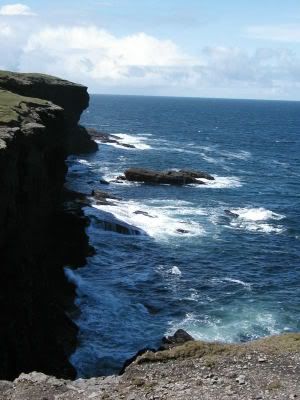
But the place that I’ve been drawn back to time and again is that verdant green Island of Poets, Ireland. During my two trips there I have repeatedly found myself transported by the friendliness of the people, the awe-inspiring vistas, the heart-lifting music and above all, the craic.

“The craic is mighty tonight,” a young man named Padraic told me as he and his cousin Michael regaled me with tall tales of their family history in a bar in Killarney. I raised an eyebrow, being unable to make myself heard over the toe-tapping fiddle and bodhran duet beside me, and he explained. “The craic, the stories, the talk, ya know?”
Oh yes, I know. That melodious accent, burred by stout or good whiskey, husky with the smoke of peat fires, and rich with visions passed down one generation to the next. Every trip I’ve made to Ireland, I’ve returned home enriched with ideas and possibilities, delighted by the prospect of weaving the people and stories I met into my own tales, and eager for the opportunity to go back once more.
I’m currently finishing the hopefully final revisions on a thriller that echoes with the roar of the explosion of Atlantis; reveals the brave deeds and anguished decisions of an ancient Irish warrior queen, Maeve; spirals into the present as two lovers meet on the storm-swept cairn where Maeve is buried; and finally crescendos with one woman’s struggle to save two children.
 I’m pretty pleased with it—as I read it, I can almost feel the rhythm of Padraic’s lilting speech, the beat of the bodhran, the slashing ribbons of rain. My hope: that when I’m finished, it will be as inspiring as the island that inspired me.
Are there places that have inspired you to write? Novels that captured the essence of a locale so much that you felt you were actually there? Please feel free to share.
Slainte,
CJ
Cathryn J Lyons, MD
No one is immune to danger…
BLINK OF AN EYE is “a perfect blend of romance and suspense.” –Sandra Brown
Coming soon from Tor Books!
Check out my new reading group at http://www.cjlyons.net/
But the place that I’ve been drawn back to time and again is that verdant green Island of Poets, Ireland. During my two trips there I have repeatedly found myself transported by the friendliness of the people, the awe-inspiring vistas, the heart-lifting music and above all, the craic.
“The craic is mighty tonight,” a young man named Padraic told me as he and his cousin Michael regaled me with tall tales of their family history in a bar in Killarney. I raised an eyebrow, being unable to make myself heard over the toe-tapping fiddle and bodhran duet beside me, and he explained. “The craic, the stories, the talk, ya know?”
Oh yes, I know. That melodious accent, burred by stout or good whiskey, husky with the smoke of peat fires, and rich with visions passed down one generation to the next. Every trip I’ve made to Ireland, I’ve returned home enriched with ideas and possibilities, delighted by the prospect of weaving the people and stories I met into my own tales, and eager for the opportunity to go back once more.
I’m currently finishing the hopefully final revisions on a thriller that echoes with the roar of the explosion of Atlantis; reveals the brave deeds and anguished decisions of an ancient Irish warrior queen, Maeve; spirals into the present as two lovers meet on the storm-swept cairn where Maeve is buried; and finally crescendos with one woman’s struggle to save two children.
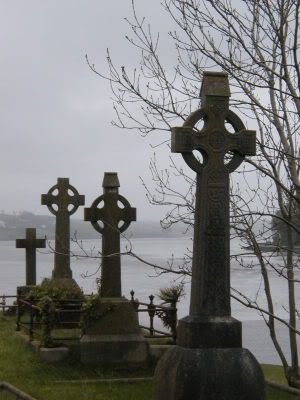 I’m pretty pleased with it—as I read it, I can almost feel the rhythm of Padraic’s lilting speech, the beat of the bodhran, the slashing ribbons of rain. My hope: that when I’m finished, it will be as inspiring as the island that inspired me.
Are there places that have inspired you to write? Novels that captured the essence of a locale so much that you felt you were actually there? Please feel free to share.
Slainte,
CJ
Cathryn J Lyons, MD
No one is immune to danger…
BLINK OF AN EYE is “a perfect blend of romance and suspense.” –Sandra Brown
Coming soon from Tor Books!
Check out my new reading group at http://www.cjlyons.net/
Tuesday, March 14, 2006
Lawsuit with The Da Vinci Code
Aren't we a sue-happy society? Are any of you worried about this lawsuit over The Da Vinci Code? That Dan Brown is having to go through this rubbish, with the authors Michael Baigent and Richard Leigh claiming Mr Brown "appropriated the architecture" of their non-fiction book, The Holy Blood and the Holy Grail, published in 1982, is amazing to me. How can anyone who wrote a nonfiction history reference book claim that Dan Brown plagiarized the facts in his fiction novel? History is history, to be intertwined in our fiction books as our imaginations take wing. The lawsuit, coming in on the tail winds of A Million Little Pieces, is just too coincidental. But that book was totally different than the DaVinci Code. I mean, it was a memoir and was supposed to be nonfiction. The Da Vinci Code is a fiction novel, for heavens sake.
On CNN yesterday, the commentator was interviewing several experts on the subject. One guy was saying that the theory of Jesus marrying Mary Magdalena and having children has been around for thousands of years. So that's not a unique idea that Baigent and Leigh came up with; it's a historical point of view. One of the fiction characters in The Da Vinci Code says that the history book wasn't correct, and that's another reason for the lawsuit. Good grief, it was part of the plot for the character to claim it wasn't factual.
On CNN, the commentator was asking the others, "What is their objective? What do they want?" The three experts said, "Money." That's it; they're jealous that their book didn't make it big and they want a piece of the pie.
Maybe Dan Brown's mistake was that he shouldn't have mentioned any of the references in his story – just like I try really hard not to mention any names of actual restaurants in my settings. But then I'm sure that a lot of people probably went out and bought those reference books to see for themselves what Dan Brown's characters were talking about. I certainly did. To me, it's like cutting off your nose to spite your face for these authors then to sue Brown after he was so nice as to mention the name of their book in his story and generate new interest in something written over twenty years ago. So if Dan Brown would have said that he got his reference material from several sources and didn't give anyone credit in his story, just made up fictitious reference books, maybe he wouldn't have been sued. Then those nonfiction authors wouldn't have gotten an increase in their sales.
I just hope that Dan Brown wins the case, and that he counter sues. If he doesn't win, won't that set us all up for lawsuits? Right now I'm studying Celtic history, and I'm thinking of tweaking the mythologies to make them fit my story. Isn't that my right as a fiction author? Or am I going to have to worry about lawsuits? (I know, only unless my book makes a huge splash like The Da Vinci Code!)
My husband says anyone can sue anybody for anything. I know that's true. We can get sued for someone walking across our property and stubbing her toe. But I hope this isn't an indicator that fiction authors are going to have to face lots of lawsuits. I don't want authors to have to start monitoring their plots, or worry about what their fiction characters do and say because fiction authors can't tweak historical facts. After all, as an expert from the Library of Congress once said to me, history is what people report. Who really knows what really happened, and how it affected a person? Several people can see the same event, but because of their perspective, their prejudices, their experience base, or simply where they're standing, each report will be different.
And remember, we are writing fiction. (And I can't wait to see the movie!)
(For more information, click here.)
Saturday, March 11, 2006
Guilty Pleasure or Student of Popular Culture?
Over on the Anatomy of a Book Deal blog, soon-to-be-published thriller writer Robert Gregory Browne mentioned that he'd turned off the Academy Awards show because to him the coverage seemed like a high school prom, with the Hollywood press more interested in who was holding hands with whom and what people were wearing than the movies themselves. So, okay, Shallow Girl here admits to watching shows like the Oscars mainly to see the clothes. Most often so I can say, “What was she thinking?” (There actually didn't seem to be that many of those moments this year and I thought nearly everyone looked appropriately movie star glamorous.)
Being on the east coast, I didn’t watch the last ten minutes — dogs had to be walked before bed — but I was glad Crash won. It, along with the equally excellent The Constant Gardener, were the only ones I’ve seen so far because I’ve gotten spoiled by my monster screen TV and hooked on the DVD extras. They both left me thinking about the stories for days afterwards, but with Crash, I actually had a lot of conversations on writers’ lists and with my workshop group about whether all that back and forth time-jumping and changing povs could be done in a book without the actors to help readers keep track. I still think all those povs (off the top of my head I remember seven) would be very, very tricky.
However, getting back to the Oscars, other people commented they no longer watch TV, and don't care about popular culture all that much. Again, putting on my sparkly shallow girl tiara, I’ll also admit that my TV viewing always seems to match the top ten-twenty of what America’s watching. This year my reality shows are The Amazing Race (amazing again after last year’s family race bust), Dancing with the Stars, Beauty and the Geek (a wonderfully sweet show about tolerance and often, like this year, incredible personal growth), and so far The Apprentice, but I may give that up pretty soon as I did Survivor and American Idol because of boredom and repetition.
Reality shows do much of what we do in fiction. Put people in stressful situations, then watch how they react. And no, they’re not real, but neither are our books, so they work for me. As do popular shows like Bones, Gray's Anatomy, Lost, The Sopranos (which YAY!! is back!), Deadwood (brilliant, but admittedly not as mainstream popular), and, occasionally, Desperate Housewives. I’ve discussed this with other writers for years and those of us with more pop culture tastes are convinced it’s helped us have long-lived careers. There’s a reason they call it Mass Market, after all.
Back in the early 80s, when I was writing my still unsold books in an Allstate booth in a Phoenix Sears store, I insured a woman who'd grown up in the hinterlands of Alaska, where her family ran a store and restaurant for workers building the oil pipeline. She told me that when she'd moved down to the Lower 48 States to go to college, her most difficult adjustment was that having been so removed from American popular culture for so long, she felt lost by references in the most casual of conversations. I'd think that would be a problem for contemporary writers who aren't "plugged in." Yet, I know successful writers who don’t ever watch TV, so apparently it doesn't bother them. Which just goes to show, once again, how different we all are.
One of the people who commented on Rob's blog is an aspiring comedian whose friend, David Feldman, was one of the first, if not the first person in the country to actually get a degree in popular culture. He's written nearly a dozen books on the subject called The Imponderables, has taught her to be proud of her viewing choices, and now rather than admitting to being a TV addict, she says she's a student of popular culture.
So, from now on, instead of letting anyone make me feel the need to defend my "guilty pleasures," I'm going to stick to my belief that hey, I'm studying popular culture! :D
Friday, March 10, 2006
Craving for cowboys?

Some romance readers love a man in a kilt, others a rugged Special Forces soldier or a sophisticated aristocrat. But for some readers none of these heroes can compare to a cowboy. Perhaps it is that so many of us grew up loving horses. How could we resist a man who loves his horse better than any other living creature up until the moment he meets his heroine?
Cowboys are often the strong silent type. They wear spurs, eat cold beans and sleep on the ground for weeks at a time without the influences of civilization. A cowboy's existence can be a lonely one. "Brokeback Mountain" notwithstanding, these tough men need the soft touch of a woman. I think that is the appeal for me. The stark contrast between a hardened man who is more comfortable with his cattle than he is with other people and a tender woman--the ultimate social creature. When my editor asked me to write a novella with a cowboy hero, this was the scenario that came to my mind and my story "Moonlight Whispers" was born.
My story appears in the anthology, My Heroes Have Always Been Cowboys, which has just been released. I play the role of the author no one has heard of, while the other two authors are well known to readers of Western romance--Lorraine Heath and Georgina Gentry. I enjoyed reading both of their stories. With no more guidance than the anthology title, we all came up with very different stories in different settings. But all three stories have this in common-- a tough cowboy hero and a woman who softens him. Mind you, these heroines aren't wimps either, but they are all women in desperate need of a hero.
When I hear from readers who enjoyed my books, they almost always add a special thank you for writing a western. There just aren't enough good westerns out there these days. If you're one of those readers who yearns for a hunky cowboy--this book is for you. The beautiful trade paperback format is a special bonus. That bare-chested cowboy looks great in the larger size.
So--what's your preference? Cowboys? Scots? Or do you like to sleep around, er, experience different types of heroes?
Thursday, March 09, 2006

I've been thinking lately about why we read, and about why we read what we read.
Some people read for edification. To learn something or to experience reality in a new way. Many of these people read because they have to--they need to keep up with markets or the doings of others in their company or because they're in one school or another and the teacher has assigned them materials to read. Many others don't "have to", but still choose their reading materials as a matter of "should." "I should read this new best-seller/classic/whatever."
Then there are those of us who read purely for entertainment. We are legion, and ageless. We range from the children giggling at the tales of Captain Underpants or waiting anxiously for the next Harry Potter book (though many HP fans are parents or grandparents) to the grandmothers catching up with their monthly subscription of Harlequin Blazes. We read because we like it. Because we can escape from our everyday lives into something different. More fun. More exciting. More...just more.
I think this is why I write what I write. It's sort of the same thing as reading what I read, only really slowly. All of us who contribute to this 2 B Read blog write romance. Romance digs into the deepest needs of human existence and promises a satisfying ending. I've added the magical adventure of fantasy to the romantic topics of love and relationships. I guess that means I'm more escapist than most--dunno. But fantasy, in the end, is about good triumphing over impossible odds, just as romance is about love winning out over despair and loneliness.
And I like being all about that.
Wednesday, March 08, 2006
The wild reader

My second book, The Naked Marquis, was officially released March 1. Yahoo!! It's already sold out at the local Borders--the one across the street from my youngest son's high school. In a few days, I'll go to other area bookstores to see if I can sign stock.
A weird thing is beginning to happen. People, even people who aren't related to me, who don't know me, are reading my book.
"Duh!" you say. "Isn't that what you expected?"
Well, yes, I realize this is the goal. Certainly I want thousands of people to run to the store and buy the book. (Hint, hint.) That's how I get royalties and maybe new contracts to write more books. And I do have an imaginary reader in my head while I'm writing and revising. I often ask myself how a reader would experience a particular scene. Is it clear? What emotion does it create? Will the reader laugh? (I write humor, so laughter is usually a good thing.) But when the book gets out there in the wild, real readers will pick it up, people who will bring their own experiences and thoughts to my words.
One type of reader I don't have in my head while I'm writing is the male of the species. I'm always a little taken aback when a man tells me he's read my book. Maybe this is because the males I live with--one husband and four sons--run screaming at the slightest suggestion they might look at my stories. Or maybe I'm just freaked that men will read all the male point of view parts and find them totally unconvincing. Or just take things in an unexpected way. One of my male friends, after reading my first book, asked me who in my life or what events inspired me to write the psycho murderer rapist villain.
Aeeiiiiee! No one. It's fiction. I made it all up. It's lies, lies, lies.
So, with a new book out, I find myself split--eager for people to read it, yet a little afraid and hesitant at the same time.
Tuesday, March 07, 2006
Minions, and why we need 'em
So here it is BOOK RELEASE DAY, one of the happiest days of the year (or three, or four, or seven of the happiest days of the year, depending on how many books/anthologies/collections you are insane enough to agree to, when you're in "sure, that would be FUN!" mode instead of "am I out of my FREAKING MIND?" mode), and all I can think about is how I need minions.
Not an assistant (have had many of those), or a secretary (ditto), or anyone for whom in any way, shape or form I need to worry about employment laws, or, you know, actual lunch breaks. No, I need a good old-fashioned minion (evil optional) who rushes to obey my every command, for fear of the death or destruction which would follow the thwarting of my wishes.
But, lacking those, I rely on my children.
Many of you are aware of my wonderful Book Release Day tradition of dragging the children on a tour of bookstores so they can OOOH and AAAH over my books. But, given their sincere and utter lack of, well, sincerity, in their previous ooohing and aaaahing, I've decided today is different.
I'm going to force them to pay me compliments. MWAH HA HA HA.
None of this pitiful "Mom, we're home from school, where is our snack?" today. No, for one precious day, it will be "Mom, we're home, can WE fix YOU a snack, in honor of release day?
"No? Would you care to relax on the couch and watch a film of your choice, without a single GAGGING NOISE during the kissing? Because you're such a brilliant writer?"
I bask, content, in the devoted attentions of my minions.
And then the alarm goes off and I wake up, bleary-eyed, minion-less, but still excited. I may not have minions, evil or otherwise, but I have the best job in the world. And today is release day. :)
Hugs,
Alesia
PS For an excerpt, to view my astonishingly fun movie-style book trailer, and more, please visit me at www.mysterychick.com. And may you find minions of your own!!
Monday, March 06, 2006
Writer's Intuition
I remembered a story the other day, and it has me thinking about a few things.
A writer was on one of my early listservs, about six years ago. She was multi-published, but had just gotten a new editor. This editor asked her for the outline of her next book, something that had never been asked of her before.
The writer took a book, put it on a sheet of paper, traced its outline with a pencil, and faxed the sheet to the editor.
I think it is safe to say that writer was what we call a "pantser." She did not do outlines and wrote by the seat of her pants.
Are you a "pantser" or a "planner?" This question gets discussed and debated among writers, and the answer appears to be interesting to readers too. Do you know your plot before you begin? How much detail do you outline first? Do you just sail into the mist without a chart, letting the story unfold as it goes, writing by the "seat of your pants"?
We know that both systems work. Neither one is more correct. I have been thinking about these differences, however, and wondering about my own "pantser" tendencies. I cling to them, even now that I have to do some planning in advance. My refusal to outline in detail goes beyond mere preference, however, and I've been wondering why.
Fiction writing has been an extremely intuitive process for me. I suspect it is for everyone, no matter how much detail gets into an outline. I have come to realize that the stimulation of my intuition is a large part of the appeal for me, however.
Are you a highly intuitive person? Do you trust your gut more than your logical analysis of a situation? Ten years ago, I would have emphatically said "no" to that question. My rational side dominated, or so I believed. In the least, I did not trust my intuitive reactions.
Writing novels changed that. Freeing my intuitive side created an intoxifying change in me. A dam had been holding all that in, and writing fiction broke the dam.
I became aware of the way stories worked themselves out in my subconscious, and how words and ideas and layers appeared out of nowhere as I wrote. I slowly came to appreciate that a balance had been restored in my spirit.
In the last few years, however, a peculiar thing has happened. This intuitive side has begun playing a bigger role in my life outside of writing. I increasingly trust my gut in many situations now. I also realize how much I did in the past too. I simply did not admit to myself that I was allowing intuition to guide me. The voice was always there and I always heard it, I just did not acknowledge it existed. At the same time, however, I am less likely to sail into the mist in my writing.
Now I wonder if a different lack of balance is forming, one where I give too much weight to those intuitive reactions outside of writing, and not enough when I write. This is the opposite of when I began my first novel.
The play between the two is important, I think. One has to check the other in order for either to work right. I can't go through life ignoring what my brain says about situations. Finding that balance as I write is important too. It can't all be intuitive.
I think that finding that balance, centering myself between the two, is essential to my writing. So I have been making some changes in how I write, to make sure the mist doesn't clear completely.
It is the surprise of discovery that makes writing and reading exciting for me, after all.
Sunday, March 05, 2006
Doing It My Way--And Doubting It
I knew I wanted to be a novelist when I was in junior high, and being the compulsive person that I am, I went to the library and checked out about half a dozen books on how to write a novel. I wanted to learn how "real" authors write. I don't know if I just got lucky or if the library skewed its choice of titles, but every single book was written by a plotter.
The more I read, the more disheartened I became. I didn't do any of these things the authors said I had to do in order to be a "real" writer. I can't say if it was only my perception as a teenager or if it really was true, but I recall there being a tone of It Must Be Done This Way in each of those how-to books.
As you may have guessed, I'm a seat of the pants writer by nature, but at fourteen, I didn't realize there were plotters and pantsers. All I knew was the books said I had to do it their way and I didn't. But I decided that I could learn. I had my mom drive me to Target and I bought 3x5 index cards. I already had the cork board, now all I needed was plot points to write on the cards.
I struggled for weeks. I had to renew the books from the library. I struggled some more. These plotter methods sapped every last drop of joy from storytelling, and I knew if I ever wanted to write, I couldn't do it like the books said.
Even in the eighth grade I was determined (My mom called it stubborn) and I decided that I was going to do it my way. I returned the books to the library and tossed the index cards in a drawer. Maybe I'd never be a "real" writer, but at least I was going to enjoy writing again. And I did. I found the fun I'd lost trying to be a plotter.
Because of this experience as a teenager, I'm very sensitive to any author telling someone they have to write one way. Whenever someone asks me about how I do it, I always end by saying, "but you should do whatever works for you. There is no wrong way to write."
But part of me is still this impressionable fourteen-year-old girl, certain that her way is somehow wrong. As much as I love to read author blogs, I have a really hard time when they start talking about their process because I never seem to do anything the same way as another author does it.
I just sit down and write.
I'm a seat of the pants writer and slow, but my first draft is usually fairly close to the final version of my book. Yes, I have holes to plug, and yes, there's a lot of clean up to do, but I rarely write scenes that don't make it into the story.
Yet it seems inevitable that about the time I'm cruising along with my writing, I'll see a blog where the author does do a lot of cutting and rearranging and I start wondering, well, maybe I'm wrong, maybe I should be gutting my stories more. I always have to remind myself that my way works for me. Maybe I'm so slow because my subconscious is working out what scene is the right one to come next.
Or I'll find a blog where the author writes her first draft in like three weeks and then fleshes it out. I can't do that. I know I can't, but I still struggle with whether this way is the right way. But I know if I laid out my story in a barebones way, it's told and I'd have to fight to work on it because my mind would be so ready to move onto the next idea. Yet there are writers who swear by this method. It works for them.
Friday, March 03, 2006
Dedication(s)
When I received the author’s copies of my latest book, For My Lady’s Honor, one of the first things I had to check out was the dedication. For some reason I always worry the dedication will get messed up in some way—or worse, won’t be there at all. I don’t know why I expect that to happen, since there has never been a single thing wrong with any of them. Even all the names have been spelled correctly!
Book dedications are really important to me. I’ve dedicated books to family, to friends, to editors—to people who have meant something to me, for any number of reasons. Once I’ve decided who to dedicate a book to, it sometimes it takes me a while to not only figure out what I want to say, but how best to say it. I always read dedications and acknowledgements in other people’s books—in part because I’m nosy (well, I am a writer—it’s not nosiness, it’s curiosity, an inquiring mind . . . sure it is:-)), and because what the dedication says tells me something about the author (maybe I am nosy).
So what does the dedication in For My Lady’s Honor say about me?
The most obvious fact is that I love my son, my daughter-in-law, and my late grandmother. Something just as important to me as honoring them was to show that my grandmother was a unique and wonderful person (I’m sure the mention of wrestling raises a few questions :-)).
Over the years I spent a lot of time with Grammy, and I learned an infinite number of things from her. As far as I know, she never wrote anything longer than a letter, but she did teach me the elusive Holy Grail of writing . . .
. . . the Secret Handshake.
You know—that mysterious something that published authors know (or so it's said), and the unpublished ones don’t?
Perseverance. Stick-to-itiveness. Sheer, unadulterated stubbornness.
Dedication.
So much of what I’ve learned about dedication, I learned from her. When you get knocked down, pick yourself up and give it another shot. Don’t be satisfied with just getting something done; do it the best you can. Be loyal to those who matter to you, to those things that matter to you—and don’t apologize for it. If you’ve done your best at something, be proud of what you’ve done, even if it doesn’t work out right this time around.
I don’t know if I’d be the kind of person willing to stick around for so long in this business without learning those skills. The romance writing biz is not for the faint of heart, or those who are easily discouraged. Being able to keep hold of the dream of continued publication in the face of reality is vital; if you don’t believe in your work (and yourself), who will?
When the going has been rough, I’ve drawn upon the stubbornness and dedication I learned (and inherited!) from her. I’m a writer. I’m still at it, and I don’t plan on quitting, no matter what.
Thanks, Grammy. You couldn’t have given me a more valuable gift.
Thursday, March 02, 2006
Careening Out of Control....
I enjoyed Allison's post about characters, especially the bit where she said something about having to let her characters grow up, and give up control.
Frankly, I'm amazed at authors who talk about making their characters do things. I've been asked to give workshops on creating characters. And I have realized--now that I have attempted to do it twice--that I have absolutely no clue how I create characters. It's such a subconscious process, that I discover them, more than create them. They're new people that I have to get to know, not characters I consciously "create." Which is probably why those charts and things don't work very well for me.
And it's probably why I have absolutely no control over my characters whatsoever.
They won't even let me name them. (Yes, I'm whining now.) I have to wait and use my development notes or my "morning pages" (which are written just as often in the evening as in the morning) to see what name bubbles up out of my swamp. Sometimes the characters come strolling out and hand me the name as they present themselves to me with a demand that I tell their story. If they won't let me name them, they certainly won't let me dictate behavior.
In my book, The Barbed Rose (Blog Break for Shameless Self-promotion: on the shelves Now, from LUNA Books, ISBN 0-373-80225-0, second in The One Rose Trilogy: End Break) I spent several months begging and pleading that my characters not make me write certain scenes. I mean, my Dad reads my books. That's worse than my Mom reading them. But no, they ignored me completely and went off and did whatever they wanted. Several times. And again for good measure.
But I wouldn't trade anything for the bunch of lunatics that live in my swamp. They might be completely out of my control, but they're a whole lot of fun. I just try to keep up with them.
Tuesday, February 28, 2006
Characters
When I first started writing, I thought I was writing plot-driven novels because I write suspense. Suspense means action and murders and plot-twists and things happening.
But as I continued writing book after book, I realized that it wasn't the plot that was propelling my stories forward, it was the characters themselves. No matter what hurdle I threw at them, they had choices to make. And those choices were made because of who they were, not because of what "needed to happen" in the story.
With children, we gradually give them more responsibility and choices to make so that when they leave home, we hope they've learned enough to make the right decisions. We're not always going to be available to tell them what to do (and if we try, they may not listen!)
But characters are grown-ups. They're individuals capable of making their own choices. I finally let my characters grow up and leave the nest. I can't tell you how hard it was to give up that control. Here I had nurtured and created some wonderful, brave people and what? I had to let them screw up? No! But the truth is, yes. Characters make mistakes just like real people. Their choices are based on their life experiences, only their life experiences are what we've given them in their backstory. Or, what they've told us.
In THE HUNT, my heroine Miranda Moore is the sole survivor of a brutal serial killer who rapes and tortures women. I sort of understood her, knew her. Her mom wasn't around. Why? I didn't know until I started the chapter where she talks to her dad. Then I learned that her mother died of ovarian cancer when Miranda was six and that's why her dad left his fast-paced corporate job for a quiet life in Montana.
I knew that Miranda had been physically scarred, but I didn't know how it truly affected her until she looked in the mirror after a shower and knew exactly how many scars were on her breasts. It was a short, powerful scene that I never knew I would write until it happened.
Character is not just reserved for the hero and heroine. A story is richer because secondary characters add depth, conflict and emotion to the story. A villain needs to be real, not just a caricature of evil. Why is he the way he is? Why does he hurt people?
These are the things about characters that they know, and they tell us when they're ready. When we, their storyteller, allow them to be themselves. When we're ready to listen.
Isn't it true that we remember books based on the characters more than the plot? The last book you absolutely loved, why did you love it? Because of the cool plot, or the fascinating characters?
So while I write suspense with a lot of external things going on, first and foremost I write about characters. They're driving the story because without them, everything is simply a series of meaningless events.
Monday, February 27, 2006
Reading 4 Pleasure
One of the worst things about becoming a writer is the way it has affected my reading. Ann asked in the previous post, how we indulged ourselves. And the question bugged me all day. I *used* to indulge myself by reading. It was my greatest pleasure. (Well, up there close to the top of the list, anyway. And one of the few great pleasures you can do--and in fact, do best--by yourself. ) And it was such a guilty pleasure. There were always things that I should have been doing. It made it seem all the more like I was giving myself a treat, which made reading a real indulgence.
Then I started actively writing and found myself critiquing everything I read. That took some of the joy away. As I became a better writer, I learned not critic quite so extensively, partly because I also learned that I didn't have to finish every book I started. If I can't get into the book enough to shut the critic up, I quit reading. As I became more secure in the strength of my own writing, I felt less obligated to 'learn' something from every book I read. That also took some of the pressure off and gave a little of the pleasure back. I also gave myself permission to go back and study later--I don't have to stop in the middle of the book and examine how or what the author did so right--the books or passages that impress or blow me away, that helped bring back some of the enjoyment. But where is the indulgence? Where's that guilty sense of pampering myself, just because I settle down with a book?
Part of the problem, I'm sure, is that I read very few books, for no other reason than I want to read them. There is never enough time. My 2 B Read pile, if all stacked together, would rival Mt. Kilimanjaro. But when I start looking at the various stacks for what to read next, at least 2 dozen books seem to holler, "Hey. Me, next. You *need* to read me." There are research books, books from a publisher or market I'd like to submit to, books by friends, books to judge for some contest. In other words, books I *need* to read for some reason that has nothing to do with the pure joy of reading. That doesn't mean that I don't find books I enjoy along the way. (One of last year's RITA books was a surprising joy, especially since it was in a subgenre I don't normally care for.) It all means that reading isn't the greatly anticipated indulgence it used to be.
It isn't even as much fun to buy books. I remember when a couple of hours wandering in a bookstore brought almost as much pleasure as reading. The big challenge was not buying more than I could afford. Now, I rarely find myself buying books that don't have some 'reason' attached to them. It's like reading has become part of my job. (And I remember when that thought would have excited me sooooo much. Getting to read as part of my job? Who could ask for anything better?)
I know I can't be the only one who has felt this way. So, how do I 'fix' it? How do I bring back the passion and the joy of it? I sure hope someone has an Rx. I sorely miss the guilty pleasure.
Sunday, February 26, 2006
Indulge Yourself
Used to be, every holiday I’d lock the bathroom door, leaving my husband to deal with the girls, and take a long, luxurious bubble bath. Inevitably one daughter or another (we have three) would knock on the door and demand to come in. Because t I needed that small piece of alone time I ignored their pleas. But someplace along the way the baths stopped. Too busy to spare the time, I guess.
Now my daughters are grown and on their own. Even so, it took a friend’s thoughtful gift to lure me back to the tub. For my birthday, this friend bought me six Lush bubble bath balls, each with a different scent and shape. I’ve been using those balls, half at a time—they’re big!—for a Sunday morning indulgence. So pleasant to relax in a scented, suds-filled tub, listen to music, and let my mind wander. I always emerge feeling relaxed and revitalized, ready for whatever the day brings.
What do you do to indulge yourself?
Saturday, February 25, 2006
When Art Imitates Life (or something like that)
In case I haven’t mentioned it before, I hate winter.
No. Seriously. I hate it. I hate the shivering as I climb out of my warm bed in the mornings and run across the cold hardwood floor to the bathroom. I hate the feeling of icy slush that gets inside my shoes whenever I go outside. I hate having to drive in snow and I hate having to walk in snow, and I especially hate having to move the snow that is in my driveway, whether by shovel or snowblower, which pretty much covers all aspects of snow.
Bottom line here, people, I hate winter.
So, is it any wonder then that the protagonist of my latest WIP hates winter, too?
Now, I’m not talking about a mild dislike of winter. Nope. She actually hates it. Read a few chapters and you’ll know what I mean because she comments on it. A lot.
(Probably too much I’m thinking, which is why I’m constantly having to go back and edit.)
Now, I remember back in the 1990’s, I had this heroine in a romance I was writing for Bantam who seemed to be obsessed with food. I’d re-read scenes I’d written a few days later and find paragraph after long (boring) paragraph that described food. Food she ate in a restaurant. Food she was thinking of eating when she got home. Food she’d eaten when she was a kid. I mean, seriously, the woman was obsessed with food.
My CP at the time had called me and said that I either had to stop dieting while I wrote the book, or—
Okay, she didn’t have a second suggestion. She just said I needed to stop dieting while I wrote the book. The thing was, my own obsessions were beginning to overshadow the obsessions of my characters.
So, my question for this snowy (what else?) February morning is...
For the writers out there: Do you ever find your characters have taken on your own obsessions? If so, how do you handle it?
For the readers out there: Have you ever suspected that this was happening? If so, how did it affect your enjoyment of the book?
Friday, February 24, 2006
Olympic (and Writing) Dreams
I have reached the point where I've realized that I must give up on a long-held dream. It's time that I face the facts and accept that some things just aren't meant to be.
Yep, sad as it is to admit it, I will never win an Olympic gold medal in figure skating. Even in the alternate universe where I actually learned to ice skate, if I haven't won one by this age, it's not going to happen. When they awarded the medals last night, I knew it was over for me.
I've always been fascinated by ice skating. When I was little my parents took me to see the Holiday on Ice show. I guess there was some kind of licensing tie-in with Peanuts because Snoopy from the show visited my kindergarten classroom and we "skated" around by taking off our shoes and sliding around on the floor. I have vague memories of "skating" around the house, possibly while wearing my ballet recital outfits (Mom may have to verify this). I first became aware of the idea of figure skating competition during the 1976 Winter Olympics when Dorothy Hamill won the gold medal. I dressed my Barbie doll in her ballerina outfit and a pair of short boots, and she skated along with Dorothy. But we didn't have an ice rink anywhere nearby, so it was pointless to dream of skating. I kept up with ballet, then switched to gymnastics early that summer. Later that summer, Nadia got a perfect ten at the summer Olympics, so it was gymnastics for me for a while. I did watch skating when I got the chance, and I got my parents to take me to the Ice Capades when Tai and Randy were starring.
I didn't really start thinking seriously about skating until the 1984 Winter Games. That was when I caught myself choosing and even editing my music for my short and long programs, as well as drawing designs for my costumes. I'd been on ice skates once in my life, when I was at a shopping mall rink in Dallas a couple of years earlier, and since I'd managed to stay upright and even start building speed in that first time, I convinced myself that I was a natural. In my dreams, I decided that when I went to college in a city that actually had an ice rink in it, I would start taking lessons and then stun everyone with my prowess. I started exercising at home so I'd be in great shape for when that time came.
Of course, I soon got sidetracked by other things. I was in the band and the drama club. I went through a phase where I was going to lose weight and be a cheerleader (that didn't happen). Mostly, I wrote a lot. I filled a lot of spiral notebooks with the beginnings of stories and with story ideas. When I went off to college, I did go to the local ice rink a couple of times, but I used that time in my life to explore a lot of things. I took fencing, was involved in professional and service organizations, took voice lessons, got back into ballet, tried to get back into gymnastics (my body objected), and learned ballroom dancing. I was also writing, taking journalism classes, still filling spiral notebooks and later computer disks, and taking other classes I thought might come in handy for writing (I took fencing primarily so I could write about swordfights in fantasy books -- along with almost every other person in that class. We tended to throw a lot of bad fantasy cliche dialogue into all our bouts.). I used to criticize myself for being so scattered when it came to interests, but now I realize I was training myself to be a writer because you do need that variety of experience to bring to your work.
I guess I must not have wanted that gold medal enough, considering I've had an ice rink in my neighborhood for the past twelve years -- in walking distance! -- and for six of those years it was only a few blocks away, and I've never gone there. That hasn't stopped me from daydreaming and choreographing my programs every four years. I did reach the point where the dream was in that alternate universe where I'd actually carried through on all those grand plans (as well as not having bad knees that can't handle high impact anything or bending deeply with a lot of weight on them). I even mentally took up ice dancing for a while because I thought that was more suited to my abilities. But now, though, I have to accept that I won't even have that alternate universe gold medal. And I'm okay with that because in my universe, I think I've done the equivalent. I wouldn't trade the things I've done for a life spent doing the kind of training it takes to reach the top in a sport like that.
There are some lessons from this that can be applied to writing, or to any other dream:
1. Wanting it isn't enough.
You have to actually do something about it. If you want to be a figure skater, you have to actually get on the ice. If you want to be a writer, you have to write. Yeah, I know, duh, but you'd be surprised at the number of people who find out that someone is a writer and then say, "I've always wanted to write a book," but have never written a word. If you're not doing anything about it, then maybe you don't want it as much as you think you do. It makes a nice daydream, but if you're not willing to take the steps to get there, that's all it will ever be. If I can live within blocks of an ice rink and never go skating, I never honestly wanted to be a skater.
2. You have to do the right things to reach your goal.
All of my off-the-ice cross training, ballet classes and the like would have come in really handy if I had decided to take up skating, but those things did me no good toward the skating dream because I never actually learned to skate. Sadly, I see a number of would-be writers making the same mistakes. They write a lot of beginnings but don't finish books. They win a lot of contests, but they never submit to editors or agents. They go to a lot of conferences and workshops, but they never get around to really writing anything because they want to learn it all before they start. Contests, conferences and workshops can all be helpful, but they won't help you reach your goal until you write a book and submit it to someone who can help you get it published. Period.
3. Sometimes, hard work and desire aren't enough.
Writing groups are great for support and encouragement, but they're also bad about spreading what could be described as false hope. There's an often-repeated mythology in these groups that if you want it enough and work really hard, someday, you'll be published. I'm sorry, but that's not true. For one thing, talent really is a factor. So is luck. So is timing. There are a lot of people out there wanting the same thing, and the odds are against you, even if you are good. Look at Michelle Kwan. She's considered to have been at the top of her sport for about a decade. She's won numerous world championships. But she's never won an Olympic gold medal. There were 30 women who went to the Olympics for the figure skating event -- out of the ENTIRE WORLD. Think of the thousands of other women out there who had skills not far below that level, who were very, very good, but who didn't make the cut. Three women from the United States are competing, and it's a good bet that some of the women who didn't make the cut there could have beat some of the women from other countries who did get to go. But that's the way it works. Agents and publishers receive hundreds of submissions a week, and each publisher (aside from Harlequin) only puts out a few books a month. Do the math. It's all about getting the right manuscript on the right desk at the right time. Sometimes, someone less talented who hasn't worked as hard will sell just because of having the right material at the right time, just as a possibly less-talented, less-experienced skater will win the medal because she happened to be better on the night that counted.
4. You have to love it enough to do it for its own sake, not for the ultimate reward. Otherwise, you'll go nuts.
If your life as a skater is worthless without an Olympic gold medal, then you may as well give up now because they only give one of those per event every four years. You're not going to drag yourself to the rink day in and day out unless you enjoy it for its own sake, unless skating brings you some kind of pleasure. That's not to say you shouldn't aim high, just that you need to be able to appreciate the process along the way enough that if you never reach that lofty goal, you won't feel like you've wasted your life. It needs to bring something to your life beyond just that one medal. The same goes with writing. If you don't enjoy it enough that you'd do it even without the hope of publication, if you wouldn't be making up stories in your head no matter what, then you'll only make yourself miserable if you keep slogging away just because you want to make some money eventually. If you do luck out and get published, you're still going to have to keep writing, and you'll be writing to deadline, so you'd better find some pleasure in it because it only gets harder. There will be days that aren't fun, but if the only thing that will make you happy with writing is selling a book, then you're setting yourself up for misery.
I guess the bottom line is that focused work is what separates goals from daydreams, whether you're a writer or a figure skater.
Thursday, February 23, 2006
The shape of things to come
Remember a few years ago when the conversation was all about ebooks and whether or not they would change publishing forever?
Ebooks haven't become the rage many were predicting ten years ago, but they are definitely here to stay. And they have changed the way many people read. (I suspect it will continue to change things, slowly and subtly, for many years to come.)
Here's a new one: how about free books on the internet? HarperCollins is 'publishing' a non-fiction book, sponsored, not by sales but by advertising. No one is predicting that this is the wave of the future, but it is an interesting concept. And if it's successful? Well, you know publishers mostly worry about the bottom line. How could a trend like this affect the way people read or buy books?
Or how about this one? (If you're lucky) Stephen King may call your cell phone. This is mostly promo, but it's interesting. And this is where you make sure he has your number.
Do things like this have long term impact on the way readers chose or read books and how our industry does business ? Look into your crystal ball and tell me how technology is going to change reading and writing (for fun and profit) in the next 10, 20 years. What's next?
Wednesday, February 22, 2006
Champagne, confetti and congrats...
...to Pam Mellor whose book, Pleasure Beach, was shown in a USA Today article on the popularity of erotic romance, and to Eve Silver for her latest contract offer from Kensington for three more historical gothic romances.
Tuesday, February 21, 2006
Plot and Prejudice

I’ve got a contest running over on my site where I ask readers to tell me some of the things they like or don’t like in a romance novel. One reader said, somewhat sheepishly, that she liked secret baby stories. Another liked the marriage of convenience plot. Still another said she couldn’t stand heroines who were TSTL (Too Stupid To Live). Kick-ass heroines are popular, but in the regency period when my novels are set, a heroine who is too kick-ass is going to get her sweet little derriere booted out of Almack’s.
I confess as a romance reader I come to a book with certain expectations...well, prejudices, really. Like CJ’s judge, I’m not a fan of short heroes. I don’t care for regencies set in France. I like paranormal, but usually not in my historicals. As a writer, however, I want to push the envelope. I don’t want to tell the same story everyone else is telling--or the same story I wrote in my last book. Yet I do feel a need to stay within general expectations. If I go too far a field, not only won’t my editor like it, more importantly, my readers won’t. And really, once I get into a story, the characters take over and tell me what to write.
So, what are your plot prejudices? Any plots you love, plots that are almost an autobuy? (It's okay if you like secret baby amnesia cowboy stories!) Would you pick up a book with a Transylvanian hunchbacked dwarf as a hero or is tall, dark, and handsome the only way to go?
I need a Hero!
Who do you think of when someone asks you who your hero is? Is it a real person or a fictional character? Is he tall, handsome, smart, rich? Or are there other qualities that are more important?
I was doing my usual end of the year de-cluttering—which basically involves moving piles of junk into new piles—when I came across a judging sheet from a contest I entered when I first joined RWA. Now, I’ve only entered 3, maybe 4, contests so I don’t know if this judge was typical or not, but her response to my entry is something that I’ll never forget.
See, my hero wasn’t six feet tall. A fact that actually endeared him to the heroine but that caused this judge to deduct multiple points and to write in several areas of the score sheet comments along the lines that I was “obviously a novice and knew nothing about the conventions of the romance genre”, that my novel “although well-written will never make it past a first reader at any publishing house unless you change your hero”, and “no New York editor will ever buy a book featuring a hero less than six feet tall.” There was more of the like, but you get the drift—she loved the story, liked the characters, but in her mind the entire work failed because of one physical characteristic.
At first I laughed. Especially as these results came on the heels of my Golden Heart final, winning the Golden Gateway and receiving my first book contract—not for the novel she judged, that was a work-in-progress. But then I realized that I was very much indebted to this judge and her comments.
Why? Because she made me think. She made me take a good hard look at my characters and consciously decide what I wanted readers to see, feel and think about them.
To do that, I examined my own personal heroes. I have three men that I truly admire—two of whom that I’ve actually been fortunate enough to meet.
The first is Joe Paterno. If you don’t follow college football, you probably don’t know Joe Pa. He’s 79 and the long time coach of the Penn State Nittany Lions. This year he brought my Lions back from several heart-breaking losing seasons to a fantastic season that was only one second shy of perfect. But Coach Paterno’s mastery of the art of football isn’t why he’s my hero.
Joe Pa is my hero because in all his years, winning or losing, he’s never lost sight of the fact that football really is only a game. He’s always focused on the people playing the game, these young boys entrusted to his care and tutelage and who, for the most part, leave the program as men of principal and honor. His teams have had some of the highest graduation rates, highest GPA’s, and highest rates of post-graduate degrees of any in the nation. Joe (and his wife Sue) tutor “their kids”, have donated heavily to build a new library at Penn State, and have always opened their arms and their home to any player in need. Joe Pa is a gentleman in the true sense of the word.
My second hero is Gene Krantz. Yeah, you remember him from Ed Harris’ portrayal in Apollo 13. He’s the guy who coined the phrase “failure is not an option” and who literally saved lives by thinking outside the box. In this case, by configuring a square box, a carbon dioxide scrubber, to fit into a round hole. He’s also known for wearing vests that his wife made him during each Apollo mission he worked on. Cool under fire, knowing when to follow the rules and when to scrap the rule book, a guy you could depend on without hesitation.
My final hero is my Uncle Vinny. No laughing, that really is his name. On a school teacher’s salary, he and his wife raised five wonderful kids (I’ll never live it down if any of my cousins are reading this!) and created a home that was always filled with music, laughter, warm comfort, hot food and endless hugs. He taught me that any dream worth having is worth sacrificing for, that people come before money or reputation, that some principals you must defend or risk losing part of yourself by compromising them, and that when you look at the big picture, there just really isn’t a whole lot in this life worth getting too upset about. If you have your health, your family and a job you love, then you’ve got it all—so go, enjoy it already!
So those are my heroes. None of them are tall, dark or Hollywood handsome—I’m sure my judge would have given them all low scores. But I strive to include part of them into all of my fictional heroes. The best compliment any reader could give me is not when they tell me, “Ohhh, that Drake is soooo hunky and handsome, he made me melt!” Rather, it’s when someone says that they’ll never forget Drake (or any of my heros), that he inspired them or made them wish they could meet a man like him in real life.
When that happens, I thank Joe Pa, Gene and Uncle Vinny. I couldn’t have done it without you guys!
So, who are your heroes? What makes them stand out, become unforgettable, inspiring?
I’d love to know!
CJ
Cathryn J Lyons
No one is immune to danger….
BLINK OF AN EYE, “a perfect blend of romance and suspense.” --Sandra Brown
www.cjlyons.net
Monday, February 20, 2006
Book Thoughts
Read a number of books last week. Got a second round of Rita books to read this week. (I read fast, so I figured I ought to do what I can--especially since that Book That Wouldn't End finally did.)
Anyway, last week, I read Catspell by Coleen Shannon; A Vision of Murder by Victoria Laurie; To The Brink by Cindy Gerard; My Lady Gamester by Cara King; Goddess of the Rose by P.C. Cast and Shadow Touch by Marjorie M. Liu
Hmm. Seems once again, I bounced through at least three different genres--maybe four, since the Laurie book is shelved with the mysteries in the store, not romance. (Her "detective" is a professional psychic with an FBI boyfriend--in this book, she invests in a house to "flip" that's haunted and gets in trouble while she's trying to resolve the haunting.) I liked all of these books, but two of them really punched my buttons.
I really loved the Gerard and the Liu books. Cindy Gerard also writes for Silhouette Desire--her bodyguard books must satisfy her inner need for suspense. This one is a very taut adventure suspense that travels from Florida to the Philippines and back, with a hot, believable reunion romance threaded through it. I even liked the flashbacks.
Marjorie M. Liu's book follows her debut Tiger Eye, but the books are so loosely connected, it doesn't matter if you've read the first one or not. The hero is a Russian with a paranormal talent--he can read history from everything he touches. The heroine has her own talent--healing. They're kidnapped by the same evil organization and encounter each other while being dragged through the corridors. This is another taut thriller with some very interesting additions and some great angst.
What have you read lately that you really loved? Why did you love it?
Saturday, February 18, 2006
The Other Obsession
Regular readers of this blog might have noted my post of a week or so ago in which I blogged about Binge Writing--the kind of writing that takes place as one is sliding into the end of a book.
Then there is the other sort of obsessive writing. The kind that takes place when one is beginning a new book. Most professional writers (whether published or not) tend to begin a new story almost as soon as they finish the old one. We might take a week or two, or a month, or a few days off. We might plunge in immediately upon sticking the previous book in the mail. (This is especially true for those with tight, back-to-back deadlines *cough*JoAnn Ross*cough*)
But I've found, no matter how long or short a time I take off between books (and I'm one of those that usually needs at least a day or two just to clear the brain), once the new book is launched, I become almost obsessive. The characters fill my mind. Plot points buzz around, possibilities crowd each other. I'm anxious to get started every day--even on the weekends, when I usually don't write--just to see what happens next.
Sometimes whole books can be written in this white heat of excitement. Most often, the obsession fades into the sort of day-to-day slog that can make writing sound no fun at all. But while I got it, I fully intend to enjoy it.
--Gail (happy with the sexy Victorian steam-punk blood magic fantasy she's started)
Friday, February 17, 2006
From a Reliable Source
HarperCollins's Avon Books imprint is expanding its reach in one of the strongest genres of women's fiction, erotica, and launching its own line to produce trade paperbacks on the topic: Avon Red. Noting that the popularity of the genre is "increasing steadily," Avon's publisher, Liate Stehlik, said the imprint will look to "provide the best, most sophisticated erotic fiction available."
Following other romance publishers like Kensington, which announced its own erotica-dedicated line called Aphrodisia in October (PW Daily 10/28/05), Avon will also publish its new imprint's titles as e-books (a format which is particularly popular among readers of the genre). Avon Red will launch in June with two anthologies—Parlor Games and If This Bed Could Talk—with plans to release one title per month beginning in September. The imprint has already signed six titles in total, among them Toni Blake's Swept Away (September) and Cathryn Fox's Pleasure Control (December).
Following other romance publishers like Kensington, which announced its own erotica-dedicated line called Aphrodisia in October (PW Daily 10/28/05), Avon will also publish its new imprint's titles as e-books (a format which is particularly popular among readers of the genre). Avon Red will launch in June with two anthologies—Parlor Games and If This Bed Could Talk—with plans to release one title per month beginning in September. The imprint has already signed six titles in total, among them Toni Blake's Swept Away (September) and Cathryn Fox's Pleasure Control (December).
Thursday, February 16, 2006
The Call
The Call came last Tuesday, right after I drove away from school, my day job. I almost didn't answer the phone. I was in the car and figured it was probably one of my sons calling. Whatever they wanted, we could discuss it as soon as I made it home.
But I was still in the parking lot so I flipped open the phone. Maybe a ride hadn't come through.
"Terry, this is Paula, from Harlequin."
I pulled over.
The rest of the conversation is somewhat of a blur. Of course, I couldn't find the notebook that I always carry in the car (located it as soon as I pulled into the driveway and reached behind me for my purse!). I had to rely on my memory when I recounted the tale to my husband but the gist of the discussion came through loud and clear: "We want to buy your book!"
During my beginning writing years, I used to daydream about The Call. I wrote dialogue in my head for the editor and me, envisioning the kinds of things the editor would tell me. I wasn't sure what would be said, since I didn't have a writing group at that time and had never talked to a 'real author.' I had to rely on my imagination. I have to admit, some of my daydreams probably bore a strong resemblance to Ralphie's, from A Christmas Story, when he writes the greatest theme ever!
My first call came several years ago. Only certain aspects of that call are clear, also. Where I was standing when the phone rang. The fact that my mom was visiting and sitting just a few feet away from me. But just thinking about that afternoon can bring back the thrill of knowing that my words were going to be published, that my name was going to be on a book. Better than any daydream I ever had.
At one time, I wondered if the excitement of getting The Call would diminish. There would only be one first call, one first book. Would my heart race and my breath catch the next time?
For me, it does! I think it's because each book has been a new and exciting adventure. The Call last week was my first call from Harlequin and it's for a new line. The book is one that has been close to my heart since I first wrote it. It's a little different than my other books, longer in both words and time period, and not the type of book that was being published. But the story wouldn't leave me alone, I had to write it, and then I bided my time, writing other things. Once I heard about Harlequin's new line -- first called Epic, now Everlasting -- I knew where I was going to send my manuscript.
This week, I've been bombarded with congratulations from friends in town and online. The outpouring of good wishes have kept me smiling so much, I feel like I'm back at my wedding. When I'm in the midst of the revisions and business aspects of this new adventure, that's what I'll fall back on to keep going.
And, of course, the thrill that winged up my spine when I heard those first words: "Terry, this is Paula, from Harlequin."
So, how does/did The Call affect you? And, please, let me know the excitement never goes away!
Wednesday, February 15, 2006
Champagne, Confetti and Congrats...
to Stephanie Feagan for her sale to Natashya Wilson at Silhouette Bombshell. Tentative title is BLOWOUT and the book is about a petroleum engineer who fights well fires and searches for those responsible for a succession of blowouts that spark a worldwide oil crisis and the possibility of another World War.
A Valentine's Bouquet
Even though my backyard is filled with snow and ice, I have a vase of tulips on my desk. They remind me that spring is just around the corner, but they also have a special significance for my life as an author. They are a gift from my local Romance Writers of America chapter for my book sales for 2005. And the wonderful part is that I wasn't the only one to receive a bouquet.
Every year, on the Sunday closest to Valentine's Day, my chapter celebrates its achievements with a Valentine's Brunch. We've done it for 11 years, ever since Harlequin author Joyce Sullivan introduced the tradition. It's a chance to recognize all those accomplishments it's so easy to overlook in a busy life and career. A book sale. A good placement in a writing conference. Volunteer work for the chapter. We even have awards to take the sting out of dreaded rejection letters. And the highlight is the Jo Beverley First Book Award, named for one of the founding members of our chapter.
I received my first book award two years ago. There is my book cover on the wall, beautifully framed, to act as inspiration. This year, it was a delight to watch our latest winner glow as she accepted her award.
Now it is my chance to 'pay it forward'. Next month, I'm giving my first solo writing workshop. I've called it 'Burning Up the Page' and, surprise, it's about writing erotic romance and love scenes. Even though I write erotic romance, I'm one of those shy and retiring authors, so no doubt I'll blush the whole way through. But by giving a workshop, I will have challenged myself and will have met another goal.
And that's why my tulips make me smile. They remind me that good things blossom when you have support to reach for your dreams.
Monday, February 13, 2006
If Not Now, When?
If I am not for myself, who will be for me? And if I am only for myself, what am I? And if not now -- when?"
-- Hillel
Recently my father-in-law passed away. Grief has hit me in unexpected ways. I think about how short the human lifespan really is.
My father-in-law lived nearly 91 years, which is but a blink in time. On the other hand, 91 years is along life span for human beings. A person can accomplish a great deal in 91 years. I suppose that’s why the above three questions have been on my mind.
Social and family issues aside (those would take a whole other blog ...), I’ve been thinking what I want to accomplish as a writer. Which brings me to three friends, all writers. I named us the Goal Girls because when we get together, setting and reviewing goals are our main purpose. We meet roughly every other month to review our goals and when necessary, tweak them. Most important, we hold each other to those goals. So they’d better be concrete, reachable, and measurable. We also drink coffee, eat lunch, laugh, cry, gossip and occasionally meet for something non-goal related, like have our Tarot cards read.
A few weeks ago we met to review our one and five-year professional goals. Putting this plan together was hard! But the Goal Girls know that in order for the Universe to provide, we must set concrete goals for ourselves. I like to set hard to reach (but not impossible) goals for myself. Looking at the three questions above) if I don’t push myself to excel, who will?
Helping my writer friends, in particular the Goal Girls, accomplish their goals and dreams is what I will do to answer the second question.
The third question, if not now, when? Applies to all of us. It is so easy to put off chores or hard work with excuses. How many of us have never said, “I’ll do it later?” I catch myself saying that more than I care to admit.
I guess what I’m saying is, despite the short time we are here (if you believe in reincarnation, and sometimes I do, I’m talking THIS life), we can accomplish a great deal, especially we have a concrete (though fluid and changeable) plan in place.
Happy goal-setting!
Wishing you your wildest dreams....
Sunday, February 12, 2006
Sunday thoughts
It occurs to me that I don't actually have any Sunday thoughts. Sundays are for not-thinking. And church and naps and and working the NYT crossword puzzle (which I'm not sure qualifies as real thinking--and I didn't cheat today but a little tiny bit) and stuff like that. And for reading.
Is there anything better than curling up with a good book on a lazy Sunday afternoon? And now that I've finished the Book That Would Not End, I'm taking a few days off to read.
This past week, I read four really good books in four different genres/subgenres. Anne Stuart's The Devil's Waltz is a Regency era (I think--19th century British, anyway) historical romance with her patented so-bad boy. Rachel Gibson's Sex, Lies and Online Dating is a contemporary romantic comedy with a dash of suspense. To the Brink by Cindy Gerard is a hard-driving romantic suspense adventure-in-the-jungle, and The Destined Queen by Deborah Hale is a romantic fantasy about a war of liberation with magic. I enjoyed every one of them immensely. (Hmm--I read Cathie Linz's Good Girls Do, as well, but couldn't find it when I went looking for this week's books...it was great too--a really fun romantic comedy with depth, about a librarian and a bad boy.)
I think I read so many different types of books first, because it takes a lot of books to fill me up, and second, because I'm the type that likes a lot of variety. My dad has lived on the Breakfast of Champions--his bowl of Wheaties--as long as I can remember, and my mom's about the same. I want something different nearly every day. (Though I do occasionally binge on Honey Nut Cheerios several days in a row.) When I order fajitas in a restaurant and people ask whether I want beef or chicken, I usually say "Can I have both?" And I like my quesadillas with spinach and chicken. Same thing in my reading. I want it all.
Anyway, I acknowledge that I probably read in more romance subgenres than most but what are your favorites and why? Which subgenres do you read outside the one you write (if you're a writer)?
Friday, February 10, 2006
Making Gold out of Silver Amalgams
There's not much worse, in my opinion, than sitting for 4-1/2 hours (count them!) in your dentist's reclining version of Dante's 9th Level of Hell (Click here for a test to see which level of Dante's hell you'll be banished to). My dentist warned me that it might be a long visit and said I might be as long as 3 hours -- the big fibber.
So on Tuesday I went prepared with things to keep me busy. I brought two novels, C.S. Lewis's Literary Essays, my Alpha Smart, notebook paper, notes from my work in progress, and even a Land's End Overstock catalogue.
The first hour passed rather pleasantly. I finished reading the first novel and cracked open the second. It seemed familiar. By page 3 I realized I'd read it two years ago. The catalogue only held my attention for about 5 minutes until I realized that all the sizes were far too small for my soccer-mom body. Next I began reading C.S. Lewis and while I am fascinated by his essays, even in the best of times (and the dental office is way below worst of times) I have to do mental gymnastics to keep up with him. Wasn't gonna happen.
After 37 shots of novocaine (okay, it wasn't really 37, it just seemed like it), the second hour passed with hair-raising accoutrements being crammed inside my pea-sized mouth, then being forcibly evicted -- like a tenant who has overstayed his lease.
During the next break, my brain was in no condition to return to good ol' C.S., so I then opened my book notes. I'm writing a romp, but couldn't feel less romp-like, so I discarded that idea as the dentist returned and ripped my lips from my face (well, that's what it felt like).
I needed a different story. Perhaps I should write something involving a serial killer with a tooth-fetish? A Frankenstein-ish creature with a drill? A beach-bum hopped up on nitrous-oxide?
When I was given a break after the third hour of agony, I ran for the bathroom, locked the door and wondered what they'd do if I refused to come out and return to the torture recliner?
The cute dental assistant Intern tapped nervously on the door after about 15 minutes and asked if I was still conscious. I assured her I was (earlier I'd assured her that I wouldn't bite her but only kept that promise for the first 2-1/2 hours, so I'm not sure she believed me this time). She asked if I planned to come out. Now this Intern was really sweet, really young, and this was her first day ever working in a dental office after 8 months of schooling. Could my conscience handle the responsibility of scaring her off the job? Ohhhh, yeah. It could. I truly thought about opening the door and running for the exit.
The problem was that my tooth had been readied, but my temporary crown was not on it yet. Once the novocaine wore off, I'd regret skeddadling before the dentist finished with me. With a sigh, I agreed to return to the hot seat.
Another hour and a half later, I finally got to leave, but was hell-day over yet? Not by a long shot. At the desk on my way out, I was forced to pay big bucks for my anguish.
I plan for revenge, though, because I managed to plot a new story with oh-so-coincidentally a villain whose first name is identical to my dentist's. The last time I had a long visit like this one, I ended up plotting (and selling to a confessions magazine) a short story about an evil dentist. Pay back can be lucrative :D -- Kathy Carmichael
Thursday, February 09, 2006
That's Amore!
Love is in the air, or so the song goes. February is the month when all the world celebrates love and romance. Valentine’s Day in the middle of the month brings it all to a peak with cards and flowers and gifts and romantic dates. But, heck, we’re romance writers--we celebrate love and romance every day of the year. Love flows through every part of our writing. Love is the most important element of the novels we write. We plan it, we feel it, and we allow our readers to experience the highs and lows of it in everything we create.
We know how important the relationship between men and women are. We build stories around, under and through relationships. We know how important it is to express our feelings of love. It those expressions and vows, or lack thereof, that give conflict and motivation to our characters. It is how we and our readers know that those characters are alive and worthy of a happy ending.
In February however, we allow ‘normal’ people to share in the wonderful world of love. During the rest of the year, we blend in (or try to!) with the rest of the world and tout the glories of being in love from behind the scenes. In February, we are no longer those somewhat strange outsiders who hear voices and see visions and write words that we are compelled to write by some internal force too strong to ignore - we are in the mainstream. Love is in the air for everyone and that includes us!
I urge to you sit back and enjoy this month because once it ends only writers of paranormal romance get to be ‘normal’ in March -- those who write of the ‘fae’ and ‘little people’ and ‘fairy circles’ will have their moment as we approach St. Patrick’s Day. For now, smile a bit smugly when someone wishes you a Happy Valentine’s Day because you know that they celebrate love and romance but once a year while romance writers enjoy it every day!
As in the past, romance authors have been asked for more interviews and invited to more events and activities during the two weeks leading up to Valentine's Day than any other time of the year and I'd like to mention two of them for anyone interested. This Thursday, February 9, 6 romance authors will be serving as 'romance experts' in a Pitney Bowes event at Grand Central Terminal in NYC! Pitney Bowes is providing Valentine's Day greeting cards and the postage to send them to anyone in world at their exhibit about the importance of communication in Vanderbilt Hall. Please stop by and say hello if you're in the area between 7am and 12noon.
The second one is the CBS Sunday Morning Show on Sunday, February 12th from 9:00-10:30am -- the program is scheduled to be about the romance industry and will feature some of the events from last year's RWA Conference in Reno, NV as well as interviews and film about romance readers' groups and authors. Take a peek and see how it turns out-- hopefully it will help us to share our enthusiasm about happily-ever- after with the rest of the world.
Happy Valentine's Day - enjoy our day!
Terri Brisbin
Wednesday, February 08, 2006
Champagne, Confetti, and Congrats. . .
PASIC member Janice Maynard not only received a glowing review on WNBC.com for her January release, Suite Fantasy, in a terrific interview, she also -- to quote WNBC columnist Michelle Buonfiglio -- "shared intimate secrets about sexual fantasy, monogamous love, and the Carter administration."
When asked what had inspired her to write Suite Fantasy, Janice responded, "We see and hear so many sleazy sex stories on the news and in movies. But psychologists tell us that fantasy can be an important part of a healthy sex life. I wanted to write about something really exciting that happens in the context of monogamous love. I basically let my imagination run wild, and Suite Fantasy was the result."
When asked what had inspired her to write Suite Fantasy, Janice responded, "We see and hear so many sleazy sex stories on the news and in movies. But psychologists tell us that fantasy can be an important part of a healthy sex life. I wanted to write about something really exciting that happens in the context of monogamous love. I basically let my imagination run wild, and Suite Fantasy was the result."
Champagne, Confetti and Congrats...
to Terry McDermid on her sale to editor Paula Eckelhoff for the brand spanking new Harlequin Everlasting line. The epic's working title is Family Stories. It follows a couple through 75 years of marriage and is seen through the eyes of their 3 daughters, a granddaughter and a great-granddaughter.
Though the series will launch in February 2007 , they haven't told Terry her pub date yet.
P.S. With all the good news lately, the confetti is getting rather deep in here, JoAnn. Where's that Bayou Bad Boy hunk you promised to send to sweep up?
Though the series will launch in February 2007 , they haven't told Terry her pub date yet.
P.S. With all the good news lately, the confetti is getting rather deep in here, JoAnn. Where's that Bayou Bad Boy hunk you promised to send to sweep up?
2 B Watched!
Our very own Terri Brisbin will appear (in what she promises is her very best disguise as a glamorous romance author) on the CBS Sunday Morning show, this Sunday, February 12th from 9 to 10:30. (EST? CST? Check your local listings.) She and Eloisa James were filmed at a Romance Readers group for a segment the show is doing all about the romance industry. You won't want to miss it.
Tuesday, February 07, 2006
Judging a Book by its Cover
We’ve all done it, walked down the aisles of a book store in a desperate search for just the right thing to read. In the mood for something different, a new author to try. So we reach out and grab…
Wait. Stop right there. Why are you grabbing that book?
Most likely because of the cover. Which happens to be a bit of a sore point for me right now because my debut release, BLINK OF AN EYE, has been delayed because of problems with the cover. That’s right, not a single word in the book has changed, but since what’s on the cover can make or break a new author, BLINK is on hold.
As much as I was anticipating BLINK’s release (and those who know me were anxiously awaiting it so that I could shut up about it already, LOL!) I see this as an opportunity. A chance to get a really smashing, eye-grabbing, you must buy this book or die! cover.
But, hmmm….what to put on the new cover? One thing my editor did ask was that I send her a new head shot. The one they’d previously chosen made me look “too kind”. Kind is bad? I asked. For an author who writes dark, edgy suspense it is, she answered. That’s what we want, a picture of you that’s dark and edgy. After all, all your books are about how no one’s immune to danger.
Oooookay, I sigh. Despite the fact that having my photo taken ranks up there with root canal in my list of things to avoid, I sign up to have another photo taken by a professional. Although by then, I’ll probably be so dark and edgy after waiting for BLINK to be released, that I might pose with a scalpel pressed to my throat or clenched between my teeth!
BLINK has been blessed with fantastic cover quotes (Sandra Brown, Heather Graham, Susan Wiggs, and more). The short synopsis of the book on the back cover and inside flap were good, catchy and compelling without revealing too much of the plot. The main problem was the actual cover art—the one thing on the cover totally out of my control, of course.
So what makes for a good cover?
For a look at some fantastic ones, check out our own PASIC finalists in the Houston Bay Area RWA’s cover art contest. Now those are some eye-grabbing works of art!!
As for what I want, I told my editor the only things I was opposed to were a woman running away or an image of a woman being victimized. Isn’t anyone else out there sick to death of frightened women racing down dark alleys, the shadow of a menacing man following them? The women in my novels are strong, smart and stand their ground, a fact that can get them into trouble, but that’s another story. And I’ve worked with far too many real-life victims to have that kind of image broadcast on my book covers.
But how do you make a cover strong, smart, sexy, appealing and able to sell an unknown author? What kind of images grab you? Make you want to plunk down $25 of your hard earned cash and take a gamble on a new author?
Anyone with the answers, please share them! And who knows, your ideas might end up helping to create a new cover for BLINK OF AN EYE!
Thanks for reading!
CJ
Monday, February 06, 2006
Confetti and Champagne!
Congratulations to our own JoAnn Ross (BLAZE) and Colleen Thompson (FADE THE HEAT) who finaled in romantic suspense in the new book cover contest sponsored by Houston Bay Area RWA!!! Our fabulous PASIC prez Kerrelyn Sparks (HOW TO MARRY A MILLIONAIRE VAMPIRE) finaled in paranormal!!! And last but not least, Teresa Bodwell (LOVING MERCY) finaled in historical!!! Check out their awesome covers.
AND one more! Geri Buckley (FOR PETE'S SAKE) finaled in the single title/mainstream category!
Woo hoo! Let's hear it for some awesome artists and the fine writers who gave them the inspiration!
AND one more! Geri Buckley (FOR PETE'S SAKE) finaled in the single title/mainstream category!
Woo hoo! Let's hear it for some awesome artists and the fine writers who gave them the inspiration!
Monday Musings...
The other day, one of my neighbors came over for a visit.
While we were sitting in my living room having coffee, I couldn’t help but notice all the furtive glances she was shooting at my TBR pile.
Okay. It’s not really one pile of books. It’s more like five piles. (And those are just the ones in my living room. I have more in my bedroom. And in my office.) I have the books sorted by their TBR order, though the order is constantly changing. Some new releases go to the top of the stack (because of great PR, for example) while others get moved down a little.
Anyway, there we were, sitting in my living room, making small talk when she suddenly turns to me.
“Why do you have so many books?”
She’d had this look of semi-horror on her face when she’d asked me the question, too. I’d seen that look before. It was the look of a non-reader. It was as if she’d just discovered one of her neighbors had a meth lab in their living room, instead of 20 odd books waiting to be read.
Anyway, as I sipped my coffee this morning, I started thinking about my TBR piles and how non-readers can’t understand the concept of buying more books to read when you haven’t finished reading the ones already stacked in your living room. But she did have a point, I suppose. It’s probably time I started making a dent in at least one of those piles.
So, my question for this soon-to-be-snowy February morning is this: How many books do you usually have in your TBR pile(s)? And how do you decide which books to read first?
Sunday, February 05, 2006
Yeah, honey, I'm working...
 Today, I'm supposed to be working on my book that's due March 1, as well as a proposal due Monday. Oh, and the one due the 13th. The deadlines are stacking up, fast and furious, and I am resolutely sitting in front of the computer...
Playing FreeCell.
Hello, my name is Shirley and I'm a FreeCell addict.
It's the dang statistics that get me. I want to see my percentage of wins increase. If I lose a game, I have to play, and win, two to make up for the lost one. Otherwise, my stats will go down. I tell myself I'm keeping my mind sharp for old age (despite the fact that I haven't yet crested the hill). That I'm giving my overworked hands a rest. That I do it for relaxation.
Yep, I'm a true addict. I'm justifying, you see. Giving all these more or less plausible reasons why playing FreeCell (instead of working) is a good thing for me. Every time I try to quit, I start dreaming about putting red Jacks on black Queens. Replaying lost games, knowing if I had moved that five instead of the four, I would have won.
People have told me to delete, to expunge the FreeCell devil from my computer altogether. Being that it came pre-installed with Windows, I tell myself something dire and cosmic will happen if I mess with Windows.
Uh-huh. That's what I said about that donut I crammed in my face yesterday, too.
FreeCell does have its merits. It requires just a bit of skill and strategy and when I am stressed, it's an instant soother. Until I look up and realize I've spent a half an hour moving cards around. Then I panic again about work.
Starting today, I am not playing FreeCell anymore. Not until all my projects are done. But wait. I haven't finished game #28159. If I resign the game, it goes down as a loss. FreeCell doesn't understand noble intentions.
Okay, one more game and then I'll quit. I promise. :-)
Shirley Jump
Thursday, February 02, 2006
Why do you write erotic romance?
My latest book, BAD BOYS AHOY!, released this month and because of that I did a lot of interviews as part of my promotion plan for the book. One of the interview questions that came up with some regularity asked why I write erotic romance.
...the pivotal turning points of the romance happen during the unguarded intimacy of lovemaking.
Basically, the sex can't be removed without damaging the story. Yes, the sex is hot and graphic, but the reasons my characters are having sex with each other are emotional. It may not be love (at first). It may be fear of intimacy, or anger at unfamiliar vulnerability. The range of emotions is wide, and each unique character has their own motivations, but in my stories falling in love happens while falling into bed.
I love it. I love writing the angst, the emotion, the passion, the romance. One of my editors, Kate Duffy, said, "Erotic romance is sexual love and desire combined with deep emotional commitment. It is not erotica. It is, first and foremost, romance, exemplified by its sexual expression."
I love expressing romance through physical intimacy, and I'm grateful everyday that the market is embracing the genre so warmly.
Interviewer: Have all your books been erotic romance stories? Why do you think you're drawn to that genre?
Sylvia: Yes, I write exclusively erotic romance. In my stories, the pivotal turning points of the romance happen during the unguarded intimacy of lovemaking. Afterwards, the increased sexual tension between the characters as they struggle to stay emotionally distant while physically craving each other is powerful, and oftentimes heart wrenching.
That's where the joy of writing comes into play for me. Those moments in a love story are what make this job my dream career.
...the pivotal turning points of the romance happen during the unguarded intimacy of lovemaking.
Basically, the sex can't be removed without damaging the story. Yes, the sex is hot and graphic, but the reasons my characters are having sex with each other are emotional. It may not be love (at first). It may be fear of intimacy, or anger at unfamiliar vulnerability. The range of emotions is wide, and each unique character has their own motivations, but in my stories falling in love happens while falling into bed.
I love it. I love writing the angst, the emotion, the passion, the romance. One of my editors, Kate Duffy, said, "Erotic romance is sexual love and desire combined with deep emotional commitment. It is not erotica. It is, first and foremost, romance, exemplified by its sexual expression."
I love expressing romance through physical intimacy, and I'm grateful everyday that the market is embracing the genre so warmly.
Subscribe to:
Posts (Atom)