Wednesday, May 17, 2006

The Next Big Thing...

Okay, am I the only one wondering what "The Next Big Thing" will be? I first discovered romance back in the historical heyday. Then I shifted with thousands of others to contemporary romantic comedy and chick lit. When Time Travels first appeared, I was mesmerized, and I was thrilled that paranormal went on to become huge.

So you don't think I am a total camp follower, there have been a few trends I just didn't get. I sampled a few romantic suspense novels during their first appearance in the limelight, but, even though I like straight suspense and love mysteries, something about the mix didn't pull me in enough to search them out. Ditto for modern heros with jobs like pilot or any variety of police enforcement/investigation. And well, erotica isn't my cup of tea. In fact a lot of the stories just billed as super sexy are a little boring to me--but maybe that's another blog.

Anyway, here we sit. The only things getting big buzz seem to be super sexy up to and including erotica, and paranormal, mainly dark. How long can these trends last? And what will push them off their pedestals? Anybody who has been watching this longer than me have a clue? A guess even? And what pushes the reigning trend off its throne? Is it a new hot movie or TV show that uncovers a hidden passion in romance readers everywhere? Or is it just complete overkill (jumping the shark) of the current Queen of the genre? Do we ever go backwards--could cowboys hit it big again? Or Vikings? (I have to admit a weakness for a good Viking tale.) Maybe a new mix--Space bound Cowboys (along the lines of the Firefly series). Or Gothic Chick Lit. (someone please write one of those--I've got to read it.) Or maybe Kick Ass Heroine Regencies. (Serve your own d@mn tea.)

Whatcha think? You can tell me...

Monday, May 15, 2006

A Room Of One's Own

Author Virginia Woolf believed that a woman needs money and a room of her own if she’s going to write fiction. Her central thesis was that every woman novelist needs a space to call her own where she can engage in uninterrupted writing time. Something male writers of that day (and probably still do) enjoyed without question. While suggesting that women’s art suffered due to a lack of space, Woolf used the room as a symbol for more complex problems -- such as women’s need for leisure time and financial independence, if their writing was to ever be taken seriously—which I’m not even going to try to tackle in a blog.

I just want to talk about the room. I’ve always written. At least since I picked up a #2 pencil and a Big Chief tablet when I was seven years old. I've written anywhere and everywhere – sitting up in an old apple tree, on the beach, on car trips, first with my parents, then later with my husband. I've written in my son’s pediatrician’s office, at his basketball and choir practices, at airport gates, on planes, sitting on a sidewalk waiting for the Fiesta Bowl parade to begin, in the woods on camping trips, and, before I had an actual office, most often at the kitchen table, which meant, of course, I’d have to clean everything off the table whenever anyone wanted to eat.

It wasn’t until I decided to become serious about becoming published in book length fiction that I actually claimed a room as my own. It was an extra bedroom being used as a storage room. At ten by ten feet, it was the smallest room in the house, but by the time I cleared out all the boxes, painted the walls a soft sky blue, and bought myself a pretty cherry French Provincial desk, that cramped little room was suddenly transformed into a refuge, a place where I could tell my stories in peace and quiet. (Relative peace, anyway. Once school let out for the day, I’d be writing with the booming sound of adolescent boys blasting away at video game aliens on the other side of the wall. )

I’ve had three more offices since that first small room. And they’ve gotten progressively larger. When I moved into this house, I was thrilled with my spacious four-hundred square feet, the vaulted ceiling, which is edged with bright white double-crown molding and soars up 13 feet, along with large windows on three sides of the room. Since the room's on the second floor, I look down on gardens or directly into the canopy of leafy green trees, which gives me a feeling of writing in a park. Continuing the outdoor nature theme, two walls are grayish-sea blue, two are a soft sea green, a compromise I came up with after struggling for weeks to choose between the two paint chips. Framed counted cross stitch and needlepoint -- created to look like Impressionist paintings -- hang on the wall, along with a framed poster of Irish cottages and Celtic wood carvings my sweetie made for me. At six feet, my desk is larger than that first desk -- although way smaller than Sue Grafton’s twenty-four foot (!) desk -- but somehow, during the course of writing a book, it still ends up covered with mountains of research texts, magazines, mail, and different colored ms. drafts. I am firmly convinced that the amount of clutter that accumulates is in direct proportion to the amount of flat surface I have in my office and by the end of a book those piles have spread to the floor around my chair.

My matching credenza manages to stay somewhat neater; while the space behind the closed doors is jammed with boxes of paper, except for a couple book posters and a stack of covers, the top is mostly my lucky baseball shrine, with, among other things, a model of Yankee Stadium; my autographed Mickey Mantle baseball, which was a birthday present from my husband years ago; a mug from Mickey Mantles in NYC, and my Yankee Barbie (wearing her pinstripe uniform, complete with warm-up jacket, mitt, and tiny Louisville Slugger), who, because of an unfortunate difference in scale, towers over the House that Ruth Built like a very stylish Godzilla about to attack Tokyo.

Because I can't edit in the same place I write, I have a pretty flowered couch on the far side of the room, but it's mostly where my dogs sleep. Heaven forbid they’d ever have to sleep on the floor, like, well. . . dogs!

I've been very happy in this bright and airy room, but then a few weeks ago, pal Cindy Gerard sent me photos of her new writer digs, and I immediately came down with a serious case of office envy. Her walls are a soothing moss green, there’s a white fireplace (which I suspect she needs more in Iowa than I do in Tennessee), and leafy green plants, which, if they’re actually real are even more impressive. She has a loveseat with gorgeous pillows (which even come with a live cat lounging atop one of them) and a pretty rug, which her dog appears to have claimed.

The room is so neat that if I didn’t like Cindy so much, I’d have to hate her, but the most enviable thing about her office is that it looks so cozy. Just the type of place a muse would love to come visit. And better yet, even stay awhile, perhaps sharing a pot of tea while telling you all sorts of fabulous secret plot twists for your story you hadn’t begun to think of. In fact, the room looks like it should be photographed for a magazine. Did I mention that if I didn’t really, really like Cindy, I’d hate her?

The pictures got me thinking about other writers’ offices. Which segued into the idea that all women, not just writers, need a room to call their own. A private room (with a lock on the door!) that’s a sanctuary. A place where a woman can do whatever she wants -- write, read, dream, play free cell and spider solitaire, and yes, do absolutely nothing, if that's her choice.

So, if Virginia Woolf’s spirit suddenly appeared and could, with a flick of her wrist, create your own personal dream room for you, what would it look like? And what items would be “must haves?”

Thursday, May 11, 2006

On Being a Scaredy-Cat

This was the week I had planned to start a new book. I spent a couple of weeks on character development and plotting, writing the synopsis, and on Monday, it was supposed to be time to actually start writing the book.

But being Monday, it was also laundry day. And the kitchen needed cleaning, and ... I knew what I was doing. I was afraid to start the book. It wasn't Writer's Block. It was fear, plain and simple.

I knew how I wanted to start it, which character to begin with and where to begin. But I was still afraid. Afraid it wouldn't be as cool as I wanted it to be. As cool as it needs to be. As cool as it sounded when I came up with the idea... the thought of turning ideas into actual words on paper had me backing away.

I've always understood Writer's Block to be a sort of paralysis. A state of staring at the blank page because the Words Just Won't Come. I couldn't didn't want to go look at that blank page. I've never really Had Writer's Block. (I know, I know. Knock on wood. I could get it any time.) I've had The Stupids (where the narrative is stupid, the dialogue is stupid, the characters are stupid and everything is just stupid, Stupid, STUPID!!!). I've had The Doubts (where I doubt whether I can actually do it, whatever IT might be). I've even had knock-down-drag-out Fights with my characters, because they refuse to do what I know darn good and well they are going to do. (My characters' cases of the guilts that they get before they've done something can really cause problems.)

Fights with characters can definitely stall things out, but I have learned that they can be resolved with some very strange-looking arguing with one's self. (Me: "Don't tell me you wouldn't make love to your heroine in a dangerous place with a busted-down door! If she jumps into your arms and wraps her legs around you, you cannot tell me you will not forget everything else to make love to her right then and there!" Myself (on behalf of the hero): "Well, okay, you're right. I would...but I'd feel really guilty about it afterward.")

When I make myself go into my lovely office with my lovely new desk (3rd picture down in the link), and actually face that blank page, it's not very long before I start writing Something. Anything. (Which, I believe is where the Stupids come from.) The problem is that fear. It can keep me away from the writing desk altogether. Which is why I make myself write first.

If I go in and sit down and begin, I generally discover before too long that it's not as scary as I thought, and I can do it after all, and, well, there are no monsters under the bed, except for the ones I put there to keep for research purposes. Lots of things are like that, don't you think? (BTW, I got my 6 pages written on Monday, plus a little more.)

Tuesday, May 09, 2006

Timing

My cat is trying to help me write this. Actually, she's standing in front of my computer screen, making a better door than a window. She's a good muse, when she's sitting elsewhere like on the chair next to me.

But it's time to pet her, and she's discovered that if she gets in my way, I'll stop what I'm doing and pet her before I put her back on the floor.

I titled this post timing because I was supposed to write it early this morning. But I didn't have time to get that done, and work called and I'm so far behind there as well as I haven't had time to catch up on all the papers which take at least 5 minutes each to grade (and I have 130).

I have a proposal due May 15. I have to make the time to do that. I carried out dinner since I never have time to cook, and then sat on my rear-end and wasted time watching The Waterboy on ABC Family. Two hours gone--except for it's been so long that I've made time to sit around and do nothing that I'm allowing myself not to feel guilty since I often don't make time to relax. I did make time to get on the treadmill for 30 minutes and get a least 1.33 miles run/walk in.

Time can be our best friend, or our enemy. Time can make us feel overwhelmed and frantic. I finished my revisions at 9 PM Sunday--they were due May 8 (Monday) at 8 AM. Talk about down to the wire.

But I've learned to simply roll with it. I can't control time. I can make to do lists, I can prioritize, and then often not, the best laid plans go astray. Sometimes this is a good thing. Monday night I took an hour and went on a walk with my 9 year old after we'd gone out to dinner. Two hours of quality time--I can't remember when we'd done that last.

My book is out this month, and except for some stock signings, I'm not doing anything fancy. No postcards, no PR, no book signings. I simply don't have time. I'm placing my book out there (one of my personal favorites) and praying that it can swim on its own without my assistance. This month, my family needs my time, and that's where I have to focus. I need to be Mom this month as school winds down. I only have a short period of time before those little girls are grown and gone away. I want to savor every moment, and I don't need to write everyday. I've freed myself from that--because me time and family time must come first.

Thus, I'll worry about that book I have due July 15 in a few weeks, once I have more time. :)

Monday, May 08, 2006

WHAT’S IN A NAME?

A friend of mine is the author of thirteen books in three genres with four different publishers. So far she’s 0 for 13 when it comes to keeping the original titles of her books. Looks like I’m on my way to catching up with her.

I recently sold my second book, a romantic suspense with a mom-lit voice to it. Think Stephanie Plum -- married, settled down with a house in the burbs and 2.3 rugrats, but still getting involved with taking down the bad guys. Except in my case, my heroine is a widow with teenagers, and she’s the one accused of doing all that bad guy stuff. So she’s got to channel her inner Sidney Bristow to save herself and clear her name. The hero, like all good heroes, lends a hand.

I came up with what I thought was a great title for this book. Unfortunately, someone else came up with a very similar title, and her book was released recently. So I have a sale, I have a release date (June 2007), but I don’t have a title.

Some people are great brainstorming titles. I’m not one of them. When I sold my first book, my publisher wanted the title I had chosen changed to something that sounded more ‘chick lit.’ I may not be good at plucking titles from the cosmos, but every once in awhile I get a great idea. The idea I had for that book was to run a contest. I posted my dilemma on some of my writing loops and on my website. Whoever came up with the title my editor chose would get credit on the acknowledgment page of my book and an autographed copy when the book was released. That’s how TALK GERTIE TO ME came about. And it’s such a great title because it has double meaning. Gertie is the childhood imaginary friend my heroine resurrects to help her cope with her menopausal mom as well as the persona she invents for her talk radio gig. I’m forever in the debt of the person who thought up that positively perfect title.

So I decided that holding a “Name That Book” contest worked well for me the first time, why not give it another shot? And that’s exactly what I’m doing. But so far the suggestions that are pouring in are more appropriate for Harlequin/Silhouette short contemporary novels. Some would make great short contemporary titles, as a matter of fact. But they’re just not cutting it for my mom-lit romantic suspense. I need help! I’ve got a blurb and chapter excerpt posted on my website (www.loiswinston.com) and the contest info on the CONTEST page. If you’re good at coming up with titles, have at it! Please!

Friday, May 05, 2006

Obsessive Book Hoarding

My name is Patti O'Shea and I'm an Obsessive Book Hoarder (OBH).

It started innocently enough. I bought a few more books than I had time to read--no big deal--I'd get to those three eventually. But before too long, my To Be Read (TBR) pile swelled to a dozen. Still manageable and everyone has books on hand to read, right?

I found out the answer to that was no. My friends were shocked when I casually mentioned I had unread books. I brought it up with a few other people because I was sure I was normal. It turned out that I wasn't. The incredulous looks, the shocked comments were all it took for me to go underground about my twelve books. After all, it was embarrassing to be the only one who bought more books than she read.

Then I bought a new computer that had Prodigy Classic software on it. I joined, and browsed the communities--and I found other romance readers. Better yet, TBR piles were ordinary, casually discussed as if everyone had one! I knew I'd found a home.

Then came the recommendations. Authors I just had to try. Topics like "Favorite First Line" and "Only Three." (The premise being that you could only pick three books to keep and you'd lose the rest. Which three would you pick?) I found more intriguing books and bought them. This is when I discovered Linda Howard and Nora Roberts and Jayne Ann Krentz and went in search of their backlists.

And the TBR pile swelled.

There were authors on the romance board. I had to try their books, right? They were online friends. So I read Rachel Lee (aka Sue Civil Brown) and fell in love with her Conard County books. And Leanne Banks and her Pendleton Brothers series. Donna Kauffman, Anne Stuart, Barbara Bretton and a legion of others. The list of authors read like a who's who of romance and I tried almost all of them.

And the TBR pile swelled.

Because I was trying so many new authors and loving them, and because an OBH must have every book a must-buy author has ever written, I began a list of Out of Print titles I had to have. I began spending my Saturdays hitting thrift stores, used book stores and library sales in pursuit of these hard-to-find gems. I was wildly successful--even finding Nora Roberts's Promise Me Tomorrow, Anne Stuart's The Demon Count and Linda Howard's then unavailable Mackenzie's Mountain. While I was looking for specific books, I'd find others that looked interesting and buy them too. I was in heaven!

And since I was spending so much time looking for books, I didn't have as much time to read them, so the TBR pile swelled even further.

The women on Prodigy Classic supported me in my addiction. Heck, they shared my addiction. We'd talk about the size of our TBR mountains with great pride. We were OBH and damn proud of it.

I started devoting more time to writing--something I'd dabbled in from the age of fourteen. Prodigy Classic had great help for aspiring authors from some very big names. Jennifer Greene organized online workshops for us, led discussions and I learned a lot! Even if I only lurked, never admitting to anyone that I was writing.

And because I was writing, I didn't have as much time to read, and the TBR pile grew even further.

I started going to writers's conferences where free books were rife. I shipped three boxes of books home from my first RWA National. Do I need to mention how fast the TBR pile was growing at this point?

Actually, the word pile is a misnomer. Even the word mountain doesn't quite work. My TBR books fill a floor to ceiling bookcase. I have them stacked double. They've overflowed beyond that space.

I own more than 5,000 fiction books. I've read more than 4,000 of them. That means my TBR list is around 1000 books long. I'm admitting it in public for the first time since Prodigy Classic closed up shop.

Are there any other Obsessive Book Hoarders out there? Anyone else brave enough to share the size of their TBR pile?

And are there any other former Prodigy Classic members out there? If so, please post, I'd love to hear from you and talk about the good old days. :-)

Patti O'Shea
Eternal Nights - Aug 2006
Through a Crimson Veil - Oct 2005

Thursday, May 04, 2006

IT AIN’T JUST A RIVER IN EGYPT

With the release of my latest romantic thriller, The Deadliest Denial, I’ve been giving a lot of thought to the various types of denial in human life. While I was writing the book, I was thinking of denial as the psychological equivalent of a life ring thrown to a drowning person in the face of unendurable pain: the betrayal of a spouse, the death of a loved one, the failure of a beloved child to live up to a parent’s expectations. Sometimes this denial turns into a desperate, self-imposed blindness, occasionally with fatal results.

But fortunately, most denial is more innocuous. Here are some of my personal favorites:

· I am going to clean out my perpetually-cluttered office once this book is turned in. (Bwahahaha! What a riot! Once the book is turned in, I will realize I am unemployed and frantically start work on a new proposal. Or two. Then I’ll do those pesky tasks, like paying bills, restocking the kitchen, and cleaning the bathroom before the health authorities show up. Any time I look at the overwhelming stacks of unfiled papers, I will immediately come up with some pressing self-promotional chore – or check my e-mail for the thousandth time.)

· I am going to walk more as soon as the pollen dies down (or the humidity decreases or the heat tapers off or – rarely – the cold snap ends). I live in the Houston area. Allergens, heat, humidity, mosquitoes, and rare cold snaps come with the territory. If I really want to walk, I’ll deal with it and do it. Daily, just like writing.

· One day, my house will all be clean at the same moment. (This is only happening if a. my mother-in-law, a famous white-glove tester type, is swooping in for a visit or some financial miracle allows me to hire a maid. I’d rather spend my days writing than cleaning something my family won’t allow to stay clean for more than ten minutes. After all, the books, once written, stay written.

· My book’s success is directly correlated to the amount of money and effort I pour into self-promotion. (I’ve mostly decided it has much more to do with the quality of the writing and universal appeal of the story, but I still catch myself panicking over not doing enough on my own. Whatever “enough” is.)

I frequently meet people who struggle with their own brand of denial in the writing department. They tell me:

· I’ll start that book tomorrow.

· I’m going to write as soon as I retire.

· You’re so lucky to have time to write (said resentfully). I have to a. work to support my family, b. raise children, c. tend to my ailing parents (as if those of us who write live in ivory towers with elves who come out at night to handle all the dirty work of life!)

· I’d be published by now, but I haven’t had the same breaks that you have. (This is always uttered by people who fail to complete manuscripts, send out queries, keep up with the marketplace, or do any of those out pesky chores associated with actual selling.)

· The only people who sell are mindless hacks like (insert name of famous, successful author). New York is too afraid to take chances on truly original work like mine. (Usually uttered by someone who’s written a 1,000-page tome on hairy, bisexual Neanderthals teleported to some technologically advanced-planet populated by goop-creatures – or something equally marketable.)

So what’s your favorite denial? And which ones are you most sick of hearing from others? Inquiring minds what to know…

Wednesday, May 03, 2006

Did you really mean that?


When I was invited to contribute an essay on the television show Desperate Housewives to the anthology Welcome to Wisteria Lane, I was sure I would write about story arc or dialogue or social satire vs. soap opera. However, as I watched Season One from start to finish on DVD in one week, something else caught my eye, literally. The sets. Television is, of course, a visual medium, and I was blown away by the skill of the production designer in using this strength to the utmost.

My essay concentrates on how the houses both reflect and give depth to the characters of the Housewives. I found all kinds of symbolism in the lack of basements (until the second season), the choice of artwork and each abode’s window treatments. I even discuss the differences in their front doors and what it says about the characters’ balance between public and private life.

That got me to thinking about literary criticism. As an English major, I used to have a grand time finding Christ and other kinds of symbolism in works of literature, and occasionally I wondered if the author really meant it to be there, or if I was just making this stuff up. Since college I have talked with many people who have the same question.

One way to answer that was to analyze my own work. How much symbolism did it really include? I discovered that my symbolism works on two levels: the conscious and the unconscious. I often deliberately include small details, such as the kind of flower a character has on the hall table or the color blouse she chooses to wear on a given day. If a reader notices these things, it will add depth to the reading experience. If the reader doesn’t catch them, it won’t detract from the book.

However, my symbolism also functions at an unconscious level. My first book A Bridge to Love is all about bridges, real and metaphorical. I consciously made building those bridges the theme of the book. Oddly enough, I have a phobia about driving my car over high bridges; if I try, I find myself in the throes of a full-blown panic attack. One evening I was at a party chatting with a fellow soccer mom who’s also a psychiatrist. She had just read the book and was complimenting me on it. Then she said, “I see you’re working out your phobia in your writing.” My mouth fell open because I had never connected the theme of the book with my fear of bridges. I felt as though I’d been smacked up aside of the head. I also felt like an idiot: there was a heck of a lot more symbolism going on than I, the writer, had been aware of.

So what do you think about symbolism in writing? Is it really there or do the literary critics and English majors make it up to give themselves something to talk about?

Tuesday, May 02, 2006

FROM A RELIABLE SOURCE

From the Chicago-North RWA Spring Fling, Rose Hilliard at St. Martins is very interested in building her list of authors. When asked a question about historical romances, she said that while the overall historical market is down, dark/sexy historicals are still doing very well.

Monday, May 01, 2006

It's Spring! (Practically Summer!)


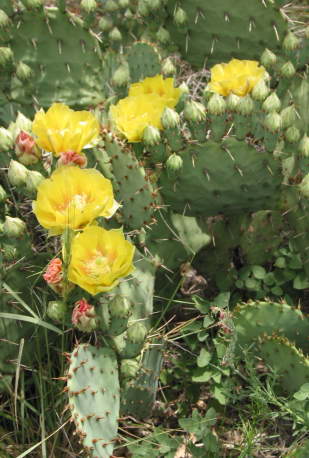
Springtime in Texas means wildflowers.

Lots and lots and LOTS of wildflowers, which are especially visible when one goes on a roadtrip. Having been on a couple of roadtrips in the past couple of weeks, I got to see lots of wildflowers. Easter weekend, the bluebonnets were still fairly thick along the roadsides--this wasn't a particularly good bluebonnet year because it was a dry winter--and the evening primroses were going pretty strong. (In Texas, most primroses are pink, shading to white, with very, very few yellow ones turning up--which are generally called sundrops.) This past weekend, the bluebonnets are almost gone, but the primroses are still out and the yuccas have begun to bloom in the places where they've gotten a little water, along with various sunflowers, tickseed and blanket flowers. There will be wildflowers all summer of one variety or another.

I don't know that the wildflowers are such a great inspiration to my writing, but I do enjoy them. I take lots of pictures of them, and sometimes I paint them. They're an inspiration for my heart and soul. They make me feel good.

And I think as writers--as human beings--we need that kind of thing. Stuff that just makes us feel good. Things we don't have to feed or pick up after or talk to, that we can just look at and enjoy. All those other things, like pets and children and spouses, are tremendously important too. They are, I think, the primary inspirations in our lives. But sometimes, you just have to stop and smell the flowers. Even if you do have to be careful of the thorns and the prickles. ;)

What kinds of things make you smile?

Thursday, April 27, 2006

Writing What -- and Where -- You Know

Several years ago, after A WOMAN’S HEART -- which would turn out to be the first book in my Irish trilogy -- came out, my son called me from a hotel in Florida. He’d just finished it, and having spent some time traveling around Ireland on his way to and from college at Oxford, he’d recognized many of the locations and thought I’d captured the scenery well. Since I’m one of those writers who believes in setting as character, I was pleased he enjoyed that part of the book.

Then he asked me how I’d nailed the Irish brogue so well. Had I, he wondered, recorded conversations during my trips to Ireland? Well, I hadn’t and his question surprised me because dialogue is one of those things I never really give a great deal of thought to. I just mostly write down the voices I’m hearing in my head. (Which is a lot cheaper than a psychiatrist and less emotionally exhausting than an exorcist. )

After I thought about it a bit, I remembered being sent to speech therapy in the second grade because no one in Southern Oregon ranching country could understand the West Irish brogue I’d picked up from my grandfather and mother. (Actually, my mother’s accent had a decided Brooklyn flair, which, when she got excited, made her even more incomprehensible.) I brought this up with my editor who said, “Well, that explains it, JoAnn. It’s your first language.” I’d never considered that before, but I thought then, and still believe, that she was right. It also may explain how, to this day, whenever I get really tired or irritated, my syntax suddenly turns Irish on me. You’ve no idea how many newly married arguments ended when I’d be trying to yell at my husband for something he’d done and he’d start laughing and say, “What the hell did you just say?”

I enjoy writing the Irish books because I know those people. They’re my family, and Brady, my heroine’s storyteller father in A WOMAN’S HEART is pretty much my own Granda McLaughlin, including the part about him kidnapping the woman he loved (my grandmother, with her permission) so her wealthier Irish family would be forced to let them get married. I feel as if I’ve come home whenever my plane lands at Shannon airport, so it’s a natural thing to place books there.

About eight years ago, we were about to buy a house in Dungarven, on the Southern coast of Ireland, when we discovered the government was actually serious about their six month pet quarantine. Since boarding my then ancient dog and equally ancient and very insane Siamese kitty wasn’t an option, the deal fell through, and looking for a new home, I landed here in East TN, which is the greenest place I could find in America. It reminds me a great deal of Ireland (except it has trees), which probably makes sense because the same mountains I receive inspiration from every day are, in fact, connected beneath the Atlantic to Ireland. It wasn’t until I moved to the South that I began to hear all the expressions I grew up with; family sayings that no one else I knew out west ever used. This is partly why, I suppose, I also feel equally comfortable putting books in the South.

So why is IMPULSE, my upcoming book, set in Wyoming? Well, because when Katrina hit the Gulf, I working on a book set in New Orleans featuring – oops – a killer hurricane, crooked cops, corrupt politicians, the mob, and a battle between good and bad voodoo. Not knowing at the time if the city would even be livable on the book’s May 23rd publication date, I came up with a new story set in Wyoming featuring a haunted hero, a hunted heroine, and a serial killer who thinks of himself as the “Man who was once the boy raised by wolves.” (For some dynamite Wyoming scenery, check out the killer video trailer at my website and be sure to turn up your sound to get the full chilling effect!) From a Southern hurricane to a Wyoming blizzard may seem like a bit of a leap, but having grown up in ranching country, I know Wyoming, and was able to make the shift.

But the one thing I’ve never been able to do is write about a place where I haven’t spent a great deal of time. Sure, the Internet offers myriad research opportunities, but I’ve always found that the people make a place. And given that my characters always come before my plots, I need to have a real handle on what makes them tick. And not just their day-to-day lives, but the entire history and backstory of their “people,” as we say down here.

I recently spent a week aboard an Authors at Sea cruise along the “Mexican Riviera” and listened to people planning stories they wanted to put in the cities – Mazatlan, Puerto Vallarta, Cabo San Lucas – we visited. But while I enjoyed the opportunity to cruise with readers and writer pals, everything was too new to me, and our time too short, to even tempt my muses.

So, do y’all have a favorite setting for books? Ones where the stories and characters speak to something deep inside you and make you feel as if you’ve been transported there? Maybe even lived there in another life? Or are you more a reading gypsy, happy to go wherever a writer’s muse takes you, discovering new and exciting places?

FROM A RELIABLE SOURCE

Agent Hilary Rubin has left Trident Media Group to become an Associate Editor at St. Martin's, effective May 3rd.
Holly Henderson Root will take over Hilary's position as audio rights agent at Trident.

Wednesday, April 26, 2006

In Praise of Jane

I can’t remember when I first became aware of Jane Austen’s work--probably back when I was in elementary school and read every book I could get my hands on (I was one of those kids who always checked out the maximum number of books allowed, then devoured them as quickly as I could). My enjoyment of her stories extends to the various movie and TV versions. Some I enjoy more than others, but I can’t think of one that isn’t worth watching. It’s always a pleasure to “spend time” in Regency England!

Despite the fact that I own--and have watched many times--both the A&E and BBC versions of Pride and Prejudice on DVD, it’s probably been close to 20 years since I actually read the book. I’d been considering reading it again (before I bought the new movie version on DVD), when I noticed that the local library was starting a reading group--and the first book to be read was Pride and Prejudice. Since I’d been looking for something that would get me away from my computer and around other people every so often, I signed up, dug out my copy of P&P and started reading.

Don’t ask me how, but I’d forgotten what a fantastic writer Jane Austen was. The DVDs are good, but there’s so much in the book that simply cannot make it into a film version. I soon found myself enmeshed in Lizzie Bennett’s’ world, loving every moment of it. It was hard to putting the book down, and I was sorry it was over when I’d finished reading it.

I can’t think of higher praise for a book than that!

The reading group discussion was fun, and it was interesting to hear what the others had to say about the book. I was surprised that several of them had never read Austen’s work--even more so that several didn’t finish because they couldn’t get into it (that shouldn’t have surprised me--I know everyone’s tastes are different--maybe my enthusiasm got in the way of my brain :-) ).

The one thing that stood out, however, was how many of us thought the book showed how little human nature has changed. IMO, that--along with Austen’s writing style and voice--helps explain why her work remains “readable" and relevant (anyone read Emma and watch the movie Clueless?).

What I got out of this experience, besides the pleasure of an enjoyable read and a lively book discussion, was that as a writer of historical romances I need to keep that in mind. Settings and situations may change, but human nature essentially remains the same. To keep a story set in the 12th century relevant to present-day readers, I need to show that my characters are real people with recognizable flaws and strengths--they just happen to live in a different time.

For me, that’s one of the neatest things about reading and writing.


I’ve been lax lately about reading classic romances as well as newly-published ones (let’s face it, there are a lot of good books coming out every week!), but that’s about to change. At the bookstore yesterday, along with Kerrelyn Sparks’ Vamps and the City and Gaelen Foley’s His Wicked Kiss, I picked up a copy of Jane Austen’s Persuasion.

Three yummy books to choose from . . . I’d better be good, maybe drag out my timer and sit myself down at the computer asap. Otherwise I won’t get anything done on my own work!

Tuesday, April 25, 2006

First Day of School


I've heard authors compare seeing their books published to giving birth to their children. I've never given birth, but I have had books published, and there do seem to be similarities to the process. Both involve growth and development that goes on inside, so that it's a very private, personal thing, and then with great effort and pain, your offspring enters the world. There's a lot of waiting and anxiety. Sometimes there are even cravings (I can't be the only person who craves certain snacks while writing on deadline). I guess the biggest difference between having a baby and having a book is that with a book you can usually see your own feet most of the time, unless you overdo it on the deadline snack cravings.

To stretch the metaphor to the breaking point, I think the day your book goes on sale must be what it's like to send your child off to school for the first time. You've done everything you can to prepare him, and now it's out of your hands. You hope he'll get a nice teacher who takes the effort to put him in a good seat where he can see the board and hear the teacher, maybe near some kids who will be a good influence on him. You hope the other kids will like him and be nice to him, and you hope he'll make friends. You hope he represents you well, reflecting well on what you taught him. Good grades and good conduct scores would be nice.

With a book, by the time it reaches the shelves, it's out of your hands. You've sweated over all those words, proof-read them, copy-edited them, checked and double-checked, but now you're sending it out into the world where it's out of your control. You hope the booksellers will be nice and put the book in a good spot where people will see it, near other books that may draw attention, but not so much attention that your book will be eclipsed. You hope readers like it and buy it, and you hope it will make friends out of them who want to come back for more. You hope it represents you well in the marketplace, and you hope it performs well, getting good enough sales that your publisher is pleased.

I get nervous before the release of each book, and I was surprised to find out that my editor feels the same way as each of the books she works on goes to market. She said that of course she thinks the books are good, because she chose them and she worked on them, but then there's some worry about what others will think. As Colleen said the other day, putting a book out does make you feel vulnerable. You're opening yourself to criticism, evaluation and judgment.

My latest baby is going out into the world today, so I hope it makes new friends and is loved and accepted. If you see it out there, please be kind!

Sunday, April 23, 2006

Real-life Romance

One of the persistent complaints of the intelligentsia about romance novels is "They're not real."

My response: "Oh yeah?"

Okay, not the most eloquent defense, and of course, all fiction has its elements of fantasy-unreality, but that lack of realism accusation seems to target one of the inherent romance reader expectations: the happy ending.

Happy endings aren't real? Baloney.

Today is the thirtieth anniversary of my wedding. Yep, I have been married to the same man for thirty years. Since we were both twenty-one. (Our birthdays are so close together, we don't even have separate ones any more. One week doesn't make much of a difference.) He's lost a whole headful of hair. Mine's gone from almost black to a lovely shade of pewter (or maybe silver). But he's still my middle-aged knight in shining armor. (Well, it might need a little armor polish these days--it's seen a lot of use...)

Not all romance writers get a happy ending, but many of us do. Some of us have to try more than once. I lucked out with my guy--but then, as I've told my children, the very best relationships are with those you're friends with first, then realize there's an extra spark. One reason why I love those "best friend" romances so much.

I personally think that a person is more likely to find a happy ending if they believe those happy endings are possible. If you're always waiting for the other shoe to drop, isn't it going to happen, sooner or later? Romances are about that belief, that possibility, that love is out there, and that it can last forever. Or at least for as long as we've got.

My fella is good at the romantic stuff, and he's the kind of guy who says "Gail, if you like both dresses, you should buy both dresses," but the real reason I love him so much... Years ago, before I ever sold a book, I was sitting at the dining table writing, and he asked what I was working on. I told him it was a new story. He said, "Oh good. I'd noticed you hadn't been writing for a couple of months, and I was starting to worry about you."

I'm hanging onto this guy for another thirty years. And then some.

Naked in Public


Do you ever have one of those dreams where you’re naked in public? It’s a common enough theme, and you don’t have to be Freud to figure out it’s all about the fear of exposure – of having people see the real you that lurks beneath the social masks we wear.

In some ways, novelists live that nightmare every day. Our books contain the blueprints of our real passions, recurring themes acted out by characters we’ve spent months or years animating with our efforts. Often, these characters say things or do things we never would (at least in public) – things that would horrify our families, coworkers, and old Sunday school teachers. To effectively write the book, we must push this out of mind and “channel” the characters without fear of the reaction of others.

In my case, this “amnesia” usually lasts all the way up until the book’s release. My debut effort was the hardest. About two days before the novel (a historical romance with one of the old-fashioned “bodice-ripper” covers) came out, I became convinced that I was going to end up in stocks in the public square, fired from my teaching job (even though I wrote under a pseudonym at the time, a newspaper article came out two days before the release and “outted” me), or worst of all, laughed at for something I cared about so much, it made my heart ache.

As it turned out, most people were genuinely thrilled for me. Publishing a first novel is a remarkable achievement, one widely celebrated and supported. This support – and the wonderful advent of fan mail - counterbalanced the few remarks that made it to my ears, including surprise that I could have written the book’s love scenes (a lot of people have the curious idea that teachers are asexual), a few armchair critics, etc. But nobody led me to the stocks, and my job remained secure until I chose to leave the classroom to devote more time to writing.

Next week, I celebrate the release of my tenth book, The Deadliest Denial, and there’s no use playing it cool and pretending. I’ll admit it here. While writing it, I held not one thing back. I poured heart and soul into this story of love and loyalty stretched to its limits – and toward it, I feel the fierce, protective passion a new mother feels for what poet Anne Bradstreet once called “thou ill-formed child of my feeble brain.”

Next week, we’re stepping forward, this child and I, together. Naked in public, and exposed.

But I like to think that in honor of this tenth outing, we’ll both be holding our heads high.

Friday, April 21, 2006

Patience, please!

I once bought a greeting card I still own because it fits me to a tee. This is what it says:

Lord grant me patience...
And hurry up!

That’s me— impatient and wishing I weren’t, but unable to change. Naturally, I chose to be a novelist, a career that requires infinite patience! But oddly enough, it suits me well. Lately I’ve been mulling this over. How can someone who wants everything yesterday be not only content, but passionately happy as a writer? I have come to realize that I am not impatient about all things. I can wait for and work steadily toward those things that really matter to me. (I’m not talking health stuff here. When someone I love needs immediate medical attention, I get pushy and very impatient. Grrr.)

But writing? For that I am willing, even eager, to roll up my sleeves, plant my behind in the chair, and do what it takes, often spending months to flesh out a story. That said, I wouldn’t be honest unless I admitted that impatience usually does strike within the first three chapters, when I am unsure of my characters and the direction of the story. (The synopsis can help, but not always). Then I yearn to jump to where I think my characters ought to be. But my books are character-driven, so skipping ahead doesn’t work. For a few days and sometimes up to a full week, I find myself unable to move forward at all. That’s when I mentally stamp my foot (the perfect picture of impatience), pull out my hair and bemoan my lack of progress. During this unpleasant time my family tiptoes around me, but we’ve been through this before, and they know the bad mood will pass. Sometime during this “dark” period I remind myself to take baby steps. That is the way a story unfolds, slowly, one sentence, one paragraph, one scene at a time. When I finally remember that (why I keep forgetting is beyond me!), the impatience fades, my mood improves, and I can proceed.

Anybody else out there impatient? If so, whether you’re a writer, a reader or both, how do you curb that impatience when writing or reading a book?

Thursday, April 20, 2006

Research Can Be Fun

Some friends and acquaintances have said that it must be nice writing fiction because I don’t have to do the research nonfiction requires. They have no idea.

For example, the setting requires research, maybe a visit. I have to acquaint myself with the geography, the scenery and the architecture--sometimes the colloquialisms and accent. Even when I choose a familiar setting, such as Maine, where I live, I have questions during the process of writing the book.

Recently, I’ve moved my stories onto a larger stage. In Breaking All the Rules, the hero and heroine go from Washington to New York City to a private Caribbean island. I had a lot of fun with creating the proper mood and details to make those places come alive. My August release, Deadly Memories, takes place in Italy, a country I haven't visited in many years. To research that setting, I sampled Italian wine and food (yum!), borrowed guide books and maps from my sister-in-law, and read books set in Italy. If you haven't read the mystery author Donna Leon, do pick up her books. Her detective is a Venice commissario, or police investigator. Not only are the mysteries intriguing, but you are immersed in Venetian culture and ambience.

I keep folders for the various topics needed for a given book, not just for the settings. Breaking All the Rules required folders on New York City, arms dealing, stolen uranium, luxury yachts, Caribbean plants and geology, and high-tech surveillance devices. For Deadly Memories I needed information on amnesia, the Italian language and slang, weapons-grade uranium, Etruscan tombs, and of course food and wine.

The Internet has made researching anything so easy that it's tempting not to do first-hand fact finding, like interviews and on-site visits. But there's nothing like being there to acquaint yourself with a place and people. In my next project, my museum-director heroine and adventurer hero must return a cursed Mayan figure to its temple in Central America. I've always been fascinated with the Maya, so it seemed logical to take a trip. My husband and I visited the Riviera Maya, with guided tours to two ancient ruin sites, Chichen Itzá and Cobá, as well as to a primitive village in the jungle of the Yucatan. Websites and books couldn't have given me the smells, sounds, and tastes of the region, nor the acquaintance of the smiling, friendly Mayan people. Think I was jazzed to write that book when I return? You bet!

Research is necessary for authenticity, but can be a trap. A writer must be careful not to make the book a dump for all she’s learned. The story is the characters and the plot, not the research. But you’d be amazed at the trivia I’ve accumulated!

Susan Vaughan

Wednesday, April 19, 2006

Aargh, the edits have landed

Aargh! This post is awfully late and I apologize. My copy edits for one of my September books arrived yesterday. And are due back Friday. Including travel time. Eek! So I'm taking a quick break to blog as my edits are the top of my "to be read" pile right now.

These are my second set of copy edits for a print book, and I am trying to devise "the system" for doing them. So far I've discovered I really didn't keep good enough notes while I write the book in the first place. Some of those nit-picky points about world-building--well, they're in my head, and in the manuscript (somewhere) but are they in a nice, orderly place I can find them? No.

Last month I blogged a bit about devising a system to create a book--a big work in progress for me. I'm not good with systems. Stephanie's post about tax time made me smile--I wish I had my receipts in a box. Mine are scattered on the floor of the spare bedroom. They were "neatly organized" before I stepped on a pile and went skidding across the floor. Next year I might move up to the box!

As for the copy edits, I am trying to be systematic. I make my change on a post-it. Think about it. Then change on computer. Then print that out. Think about it more. Then finally, when I get the courage, I pick up the eraser or the red pencil and actually commit to the change. I still find it scary to think this big, momentous 'last chance to change' has to happen so fast. On the other hand, it cuts down on the navel-gazing.

Well, back to edits. And if anyone has some great tips, I love to hear them!

Tuesday, April 18, 2006

Champagne, Confetti and Congrats...

to Lois Winston, whose Talk Gertie to Me is in bookstores now, for making her second sale.
Dorchester is buying the romantic suspense with a release date sometime in late 2007. The book originally came to life as her very first writing attempt--a 50,000 word romance that spanned 35 years. It went through a decade of major revisions and three title changes but she loved the characters and story and kept coming back to them until, as Lois says, "I finally got it right."

Friday, April 14, 2006

Google Me Curious

Disclaimer: This post represents only its author's opinion, not the opinion of the 2 B Read participants, this blog, or RWA.

Various writers' groups have come out swinging against Google Book Search. The general idea of Google Book Search is to give potential readers the opportunity to search through books for specific terms and view those instances in context. The primary issue the writers' groups -- and some publishing houses -- seem to be up in arms about is the "unauthorized copying" of copyrighted texts. Meanwhile, some major universities and some publishing houses have given Google permission to scan their texts, which is a major boon for researchers and scholars.

Some writers' groups have extrapolated beyond this immediate issue and sound almost alarmist in their language. A recent article in the Romance Writers of America Romance Writers Report outlines one of the arguments given by Paul Aiken of Authors Guild in testimony before a subcommittee on COmmerce, Trade and Consumer Protection, then concludes with the tantalizing question: "Who is going to buy a book if they can get it for free off the Internet?"

Having spend a decade in the technology industry and knowing how easy it is for a new technology to be either misunderstood or misrepresented, I decided to go see what was going on with Google Book Search. I spent a morning searching various terms (of course, I had to check on terms I knew were used in my own book published last March, just for grins) and decided the ultimate test would be to search on the term "romance." When Julie Beard's excellent The Complete Idiot's Guide to Romance Writing appeared as one of the books I could "browse," I clicked it. I have that book, and know that the word "romance" appears on almost every page. Would I be able to read or print or download vast numbers of pages?

Ah... no. I wasn't.

Here's what I found:
  • I could view an entire page where the term "romance" appeared, but only because the publisher had given Google permission to display an entire page. (Other books allowed only a "snippet" of three lines to be displayed, because the publisher had not given Google permission to display the entire page. This is explained in the help files.)

  • Even when viewing an entire page, I couldn't print the book page. I could print everything around the place where the copyrighted text was, but the copyrighted text itself was not printed.

  • While there were over 200 instances of the word "romance" in Julie Beard's book, I was allowed to view only a few of them before Google told me, in an oblique way, that I'd seen enough.
What we're missing, I think, is a rational dialogue among writers, publishers, and Google. Conversations in court usually generate more heat than light, and I have to say that I fault Google for not sending an envoy to every major writers' organization to present their case and explain how Google Book Search can be beneficial to copyright holders. That one action could have defused a lot of the ire and fear from the get-go.

But since that didn't happen, let's talk. What do you think about Google Book Search? Is it a useful tool for readers or a threat to writers' livelihoods?

Champagne, Confetti and Congrats...

to Colleen Thompson whose FADE THE HEAT was chosen by Dorchester to be given away in a marketing blitz where they partnered with Cupid.com to co-host "speed-dating" events in NYC, Washington, D.C., Atlanta, Chicago and San Francisco. Colleen was invited to give dating tips for men and women, which were included in goodie bags for the participants. One of her tips was used in a Publisher's Weekly article on the topic. Colleen interviewed some of her single, dating friends. Check out the PW article here:
http://www.publishersweekly.com/article/CA6324585.html

Champagne, Confetti and Congrats...

to Sandra Marton on the news that THE SICILIAN MARRIAGE won the Reviewers Choice Award for Best Harlequin Presents of 2005.

Champagne, Confetti and Congrats...

to Mia Zachary, for her two week (so far) appearance on the Bookscan Top 100 Romance bestsellers with her April Blaze, AFTERNOON DELIGHT. The book is also a 4.5 Star RT top pick.

Wednesday, April 12, 2006

Creative Process

The creative process is a strange one, and it never happens in quite the same way for me. I've been struggling with the first chapters of my first druid vampire book in the world I've developed. I don't know -- maybe I was thinking too hard about it because last night I developed a horrible headache.

I took ibuprophen and ended up going to bed at 9:00. But even in bed, my mind wouldn't settle down and I kept thinking about my plot and whirling it around my fantasy elements though my head was throbbing. I got hot flashes, kept throwing off the covers, flopping around in bed, putting my pillow over my head in an attempt to try to ease the pain behind my eyes, then getting cold and cuddling next to my husband, only to complain that he was making me sweat and pushing him away. I was driving him nuts -- as well as myself!

Finally, I fell to sleep. And when I woke up, my headache was gone and I felt so refreshed. What's more, I knew what was wrong with my plot, and knew exactly how I was going to approach the story! So I've been writing like mad today, fixing my world and writing down the outline to my story -- and I'm very excited.

Also, I've been searching the 'Net, trying to find a good English to Celt Dictionary. I finally found an Online Etymology Dictionary that explains the origin of English words, which I absolutely love. And I've found quite a few Celt and Anglo-Saxon words in it. Still, it's time consuming weeding through all the Latin and other origins I don't want. But I might have to fall back on some Latin roots. I want to "flavor" the book throughout by having my druids say some Celt words.

When I'm done, I'll probably set up a page on my official website with all the terminology and roots in case anyone is interested, at gloriaharchar.com.

That's the report from the salt mines!

Tuesday, April 11, 2006

Runner's high vs. writer's high


On Saturday, I ran my first 5K (3.1 miles) race ever--in the rain! I don't love to run; I do it strictly for exercise and the race was really just a way to trick myself into pushing my middle-aged body a bit harder. My goal was simple: to run the whole way, hills included (no walking allowed, no matter how much my muscles and lungs complained). And I wanted, just once, to feel the famous "runner's high".

So how'd I do? Well, I did indeed run the whole way and I finished four minutes faster than my best training time. I crossed the finish line to the loud cheers of my husband and friends, who I think were amazed that I really did it. Then I went home, took a hot shower, and fell asleep on the couch. No adrenalin or endorphin or whatever it's supposed to be rush. No high of any kind. Just a strong sense of relief that I could take a vacation from the tyranny of the treadmill for a week, the reward I'd promised myself.

I couldn't help contrasting that with writing. Yes, there are times I long to escape the equally tyrannical word processor, days when I feel I'm dragging every word out of my brain with a blunt pair of pliers. Then there are other miraculous days when I sit down at my keyboard and look up fifteen frenzied pages later to discover it's time to pick up the children from school. I'm smiling for the rest of the day.

Even greater is the high when I type those two wonderful little words: The End. Of course I delete them before I send the manuscript to my agent or editor but I wouldn't miss keying in those six letters for all the ink in New York City. Last week, I finished the first draft of my romantic suspense novel and the sense of accomplishment was beyond description. I completely embarassed my sixteen-year-old daughter (always fun to do) by dancing down the sidewalk on our way to the orthodontist's office. My joy was just too great to contain in my body; I had to express it outwardly.

Now I'm revising the manscript and that too gives me a rush. There are plenty of things that need fixing but there is also the thrill of reading a line of dialogue or a descriptive phrase so good that I can't believe I wrote it.

I guess some of us are born to run, and some of us are born to write.

What gives you your greatest "high"?

Monday, April 10, 2006

Second Child Syndrome

Remember your first baby--you read every how-to book, bought only the best organic baby food, scheduled thousands of brain stimulating activities? Then number two comes along and what? T.V and Cheetos?

Well, I'm not expecting any more children, but my second book is due to appear any time now. And, I have to admit, as much as I love this book, it won't make its appearance with quite the same splash (on my part) as the first one.

book twoNumber one I bought ads in R.T. and at a number of online review sites. I sent out tons of home-made ARCS, had bookmarks printed up, mailed press releases, and in general announced it to anyone too slow to escape me. But book two? No bookmarks. No ads paid for by me. (well a tiny $8 spot in a group thing I do.) No press releases. And a lot fewer ARCS.

What's the deal? Do I love this book less?

The answer is no--in fact I believe this book is a lot stronger than the first one, but over the past year, I've realized something that a lot of veterans could have told me easily (if I would have listened). Getting readers is complicated. A lot of the appeal of a new author and her books can be completely out of the control of the author--things like the cover, title, and back cover copy. And the big promo opps are frequently reserved for publisher dollars (either literally or just too much $$ for one author to spend)--store placement, special display units, enough advertising behind a book to get buzz.

And, let's face it--none of that matters if the book itself doesn't strike a chord with readers. So, what's an author to do? Yeah, you guessed it, write the best book you can, then if you are feeling promo-oriented, get copies of it in the hands of some key readers. (book store employees who hand sell for example, or readers who will talk it up) Then sit your behind down, limber up your fingers, and start writing the next one--Maybe it will be the one to make it big. ;-)

Sunday, April 09, 2006

Dreamstorming

I've been to two writing conferences in 11 days and I'm exhausted. I literally walked into my house about six minutes ago and realized I had to blog. Since I also have to grocery shop for the family and find some of that fabulous Airborne (?) that someone at the second conference introduced me to (I was sneezing and throaty and miserable, but the conference was still great), I'm blogging now or I'll forget.

I was fully inducted into the concept of dreamstorming by Robert Olen Butler at the conference I went to ten days ago in New Orleans. The idea is to dip deep into the unconcious mind, without censoring, allowing scenes and snippets of the story to come to you as they will (in order or not). You capture these scenes with single lines (on 3x5 cards is Butler's preferred way). Butler dreamstorms for months before he begins to write. I don't have that luxury of time--my agent wants my new book idea ASAP.

I've done a little dreamstorming in the few days I was home between conferences, and I felt was I was going places that I might not have gone in the story if I were to be so focused on getting from beginning to end, as I usually am when I create my skeletal plot synopses. But on five hour drive home from the conference I attended this weekend, I dared to turn off the radio and dreamstorm the whole trip. Wow!

All I can say is, I was lucky to be traveling the interstate early on Sunday, when it wasn't busy, because I was a little surprised when the familiar landmarks of home appeared so soon :-).

The downside to dreamstorming while driving is there is not recording on the 3x5 cards. But I can do that tonight. After I shop for the family. And take some Airborne to help me get rid of this stubborn spring cold!

Kelly McClymer

Friday, April 07, 2006

The author removes her mask to reveal . . .


Recently, one of the local newspapers, The Missoula Independent, did a feature article about my fledgling career as a romance author. This was an interesting experience for me. Like most authors, I'm used to working in quiet anonimity. My friends know that I write romance novels, but when I'm walking down the street, the average person has no idea what I do.

That changed a bit last week. The Independent is a weekly, so for an entire week--the headline Write 'em Cowgirl appeared all over town, on top of a hunky, bare-chested cowboy reading a book. It was exciting and a little (okay a lot) weird.

Doing the interview was also a new experience for me. I've done a lot of online interviews where they send me questions and I can take my time writing answers. This was different. I sat in the conference room with the reporter--who had done his research on the romance industry, had read my books and studied my website--while he tossed questions at me ranging from my interest in Girl Scouts to why the sex in my stories is so explicit.

Writing fiction is a very personal thing, so answering questions about writing means that you are revealing a lot about yourself. I tried to be honest and open. I also tried not to say anything that would be completely mortifying to my teenage daughters who also live in this town. Did I pull it off? I don't know. You can read the article and see for yourself.

It's funny in a way that this should seem so awkward to me because I reveal much more about myself every day when I write my fiction. Of course, I get to wear the mask of my various characters, but good fiction requires the author to put her emotions out there for the world to see. If you hold back, the story suffers. The mask, the props and the setting all work to keep the author hidden--like the Wizard of Oz shouting, "pay no attention to the man behind the curtain." I think the article reveals a very ordinary woman, leading a quiet life behind the curtain so that her characters can come to life on the stage.

Champagne, Confetti and Congrats...

to the following finalists in the First Coast Romance Writers Beacon contest:
Ann Macela, THE OLDEST KIND OF MAGIC, Best First Book
Kelley St. John, GOOD GIRLS DON'T, Long Contemporary
Heidi Betts, WHEN THE LIGHTS GO DOWN, Short Contemporary
Susan Squires, THE HUNGER, Paranormal
Shane Bolks, THE GOOD, THE BAD AND THE UGLY MEN I'VE DATED, Chick Lit

Champagne, Confetti and Congrats...

to Bonnie Spidle, who is sitting in the corner, glowing quietly over the news that her current release, HARD STUFF, has just gone for a second printing.

Thursday, April 06, 2006

Why Does Everything Always Happen at Once?

Wow! Congratulations to all the authors who've received such wonderful news lately! It's exciting to be amongst such company. (And maybe if I'd entered some of those contests, I'd be even more amongst them--then again, maybe not. C'est la vie.)

I'm sitting here looking at the clutter already invading the top of my new desk, trying not to think about all the things I have to do. Revisions on The Eternal Rose arrived last week, and while I have until my editor comes back from maternity leave to finish them (knock on wood that she comes back!), I hate having them sit around that long. I also have suggestions from my agent for revising the option book, and since they're good suggestions, I imagine I'll be getting to those fairly soon. And then there's all the stuff I need to do in my "real" life.

Somehow, everything has piled in at once. Not only do I still have (Um, wait, counting) about 7 books yet to read by the end of next week for the various published contests I agreed to judge (I read 14 books for the Rita. These are other contests.), I have a lot of other stuff going on.

There's a luncheon for the local "Art" club Friday and it's my turn to help host--vegetable slicing and decorating later this afternoon. Then when that's over, I get to help decorate for a wedding shower that I'm helping to host for the daughter of a dear friend. Fortunately, I was nominated to pick up the gift, so that's done. I don't have to provide any of the food or decor. The shower is Saturday morning, then I have to cook for all the college students we're having over for Sunday dinner. Oh, and there's a "quilt block of the month" class I'd like to squeeze in before the shower, with the block yet to be sewn up. And the lady who cleans my house was sick this week.

I've gotten fairly good about saying "no." Especially since the last son toddled off to college this year, but somehow, stuff still stacks up. And I know people work full time jobs and do all this stuff, but I've never been very good at keeping up with things. Adding writing in just makes me crazier. And it keeps me sane.

I suppose I'm blogging about all this--well, to whine. And to show that writers live the same, crazy, hectic sorts of lives as the rest of the universe. And because I could think of absolutely nothing else to blog about. Go read The Barbed Rose. It's a lot more interesting. :)

Champagne, Confetti and Congrats...

to the following Holt Medallion Finalists:
Kelley St. John, GOOD GIRLS DON'T
Roxanne St. Clair, KILLER CURVES, in the Romantic Suspense category
Roxanne St. Clair, WHEN THE EARTH MOVES, in the Short Contemporary category
Kerrilyn Sparks, HOW TO MARRY A MILLIONAIRE VAMPIRE, in the Paranormal category.
Cheryl Bolen, ONE GOLDEN RING, in the Short Historical category
Jackie Kramer, WARRIOR'S HEART, in the Short Contemporary category

Champagne, Confetti and Congrats...

to Sylvia Day for the sale of two more single title books to Avon. Watch for the first, a May 07 release titled MY IMMORTAL. The second will be a sequel and is scheduled for release the following December.

Champagne, Confetti and Congrats...

to Kelly Mcclymer whose young adult novel, THE SALEM WITCH TRYOUTS, was chosen for the Scholastic teen order form. Since nearly all grown up booklovers remember, with fondness, ordering books from Scholastic back in our schooldays, we shouldn't be surprised that Kelly plans to snag a copy of the book order form and frame it and hang it on her office wall.

Wednesday, April 05, 2006

Soul Mates, Reincarnation and Romance

I enjoy a lot of different types of romances, but I confess I particularly like it when the author lets me know that hero and heroine are soul mates. Maybe it's because I'm a diehard romantic who believes that there's someone out there that we resonate with more closely than we do with anyone else. Or maybe it has to do with the idea of belonging to someone in a special way. I'm not really certain of the whys, I just know I love reading those types of stories.

In the last year or so, though, I've been seeing readers on bulletin boards and blogs commenting in a negative way about the idea of soul mates in romance fiction. The reason seems to be universal--they feel the author is taking a shortcut because there's no building of the relationship.

Recently, I wrote my own version of a soul mate romance--Through a Crimson Veil--and saw comments about how I didn't "cheat." And the people who said that seemed surprised, which surprised me.

My take on soul mates isn't that the hero and heroine catch one glimpse of each other and fall instantly in love. It doesn't matter if they've loved this other soul in life after life, when they meet in this life neither the hero nor the heroine are a blank slate. They've lived, they've had childhoods and survived adolescence and young adulthood, that means they have baggage just like every other human being. It means they're going to share the same fear of falling in love that almost every other human being has. That this other person is a soul mate doesn't mitigate how scary it can be to feel something as deep as love.

Being soul mates is also no guarantee that a couple will choose to be together. Being half of a pair of soul mates doesn't negate free will. Of course, since this is romance we're writing, there will be a happy ending, but because I believe in torturing my characters, they're not necessarily going to reach it easily. :-)

In Crimson Veil, I even used the heroine's anticipation of instant rapport as a plot point. Mika knows Conor is her soul mate before they meet, so she expects him to realize immediately that she's The One even if he doesn't understand why. She quickly learns, however, that she's going to have to get to know him, and they're both going to have overcome their pasts if they want a future. No easy task because their respective lives have left them very different from each other in their views and their behavior.

Soul mates are probably a big enough topic for one blog posting, but I'm going to bring reincarnation into it too since, for me at least, they are permanently linked.

I love reincarnation romance, but it's so seldom handled well. Sometimes I wonder what kind of research the author has done because so little of it matches anything I've read on the topic, and believe me, I've read a lot! But when it's done well, the story becomes extra special. Linda Howard's "Lake of Dreams" in the Everlasting anthology might be the best reincarnation romance ever. IMO, of course.

Since the hero and heroine usually have had at least one past life together, this fits in with the soul mate idea, but the extra component I like is that not only are the hero and heroine dealing with their baggage from this life, in reincarnation romance they're also dealing with something from a past life as well.

In "Lake of Dreams," the heroine has seen how she's died in many lives, and from what she's dreamed, it always seems to be at the hero's hands. Now she's met him again, she's fallen for him, and she's trying to beat what seems to be the fated conclusion of their incarnations. The suspense is whether or not she'll be successful and they'll have their happy ending in this life at last. If you haven't read this novella, I highly recommend it. Along with being a fabulous reincarnation romance, I also believe it might be the best anthology story ever. That short format is tough!

Do I need to mention that I've always wanted to write a reincarnation romance? :-) I did it too and I used this past life to cause conflict between my hero and heroine. If Mika and Conor thought being soul mates was difficult, they got off easy compared to Kendall and Wyatt. :-) In Eternal Nights not only are the hero and heroine dealing with Kendall's baggage from a nomadic childhood where she was forced to be the adult instead of her mother, but they're also dealing with things held over from a past life. Wyatt remembers this life, but Kendall doesn't know why she's attracted to the temple or why Wyatt hates that damn pyramid. And as the story progresses, this thread becomes a bigger issue.

Are the leftovers from their past life the main conflict? No, there's plenty of this life issues to play that role, but it's a nice secondary conflict and one I like to think adds to what they're already dealing with.

Reincarnation and soul mates can make for a very compelling theme in any romance story, but writers need to do their research. Check out the New Age section at the bookstore or check out the metaphysical section at the library and read a few books on the subject if you want to use this idea. It's interesting reading and might just spark some unexpected plot threads. And if you do use it, don't forget your characters still need to work for their happy ending. Readers shouldn't feel as if they missed the "good stuff."

So no shortcuts, no love at first sight. To quote Wyatt, "more like intrigued at first sight."

Patti O'Shea
www.pattioshea.com

Through a Crimson Veil - Out Now
Eternal Nights - August 2006

Tuesday, April 04, 2006

TODAY IS GERTIE DAY!

Never heard of it? I’m using my blogging debut on this site to declare today, April 4, 2006, an unofficial holiday. Unofficial because you have to go through all sorts of legal mumbo-jumbo and expense to declare an official holiday. Besides, in the greater scheme of things, Gertie Day will mean little to most people. To me, it’s the first day in the rest of my life as a published author. Today, TALK GERTIE TO ME, my debut novel, is on store shelves from Petaluma to Paramus. (Actually, many stores wound up shelving it last week, but today is the official release date according to my publisher.)

To be honest, there were times when I thought I’d never see this day. I wrote for ten years before I made a sale. Throughout those ten years, I had lots of positive feedback, won contests, landed an agent, but was never offered a contract, even when editors told me to my face how much they loved my books. I’m probably about to show my age here, but remember the character in Li’l Abner, the one with the black cloud that constantly hung over his head? That was me. Especially when I’d receive rejection letters that praised my writing, my story, my characters, etc. but would end with, “...but ultimately I didn’t fall in love with the book, and for that reason, I must pass on it.” Honestly, my agent never asked any of these editors to MARRY my books, just buy them!

But now I can walk into Borders or Barnes & Noble or many other bookstores, stand in front of a shelf of books, and see MY book. MY baby with its bright pink cover and dancing title, its heart-shaped Manhattan skyline snow globe, its wonderful author quote from Melissa Senate, and MY NAME in big, bold letters. And after a decade-long gestation period, the feeling is numbing, humbling, and surreal. To be honest, I still can’t believe it. I have proof -- a signed contract, a cashed advance check, author copies that arrived at my door a few weeks ago, TALK GERTIE TO ME on bookstore shelves. And it still feels like I’m standing on the outside, watching all of this happen to someone else. Or like it’s all a dream that I’ll wake up from at any moment.

I don’t know if other authors have ever felt this way. I’ve never heard anyone speak to this issue. Maybe I’m just weird. What I do know, though, is that I’ve become a poster person (I think it would be stretching it a bit to say poster ‘child’) for many as yet unpublished authors. There are some authors who write a book, secure an agent, and get offered a mega-bucks contract all within the course of a few months. Then there are the rest of us, the majority of us. If after ten years, I can walk into a bookstore and see my book on the shelves, the same can happen for many others. So the moral of my story, albeit trite, is DON’T EVER GIVE UP!

Champagne, Confetti and Congrats...

to Eve Silver on the sale of her near-future, action-adventure novel, Driven, to Dorchester.

Champagne, Confetti and Congrats...

to our fantastic finalists in the Colorado Award of Excellence competition.

The Flight Doctor's Lifeline by Laura Iding, Short Contemporary category
Marital Privilege by Ann Voss Peterson, Romanctic Suspense category
When The Lights Go Down by Heidi Betts, Short Contemporary category
Through a Crimson Veil by Patti O'Shea, Paranormal category
Blaze by JoAnn Ross, Romantic Suspense category
Unknown title (to me) by Victoria Alexander


Monday, April 03, 2006

Champagne, Confetti and Congrats

to our many PASIC finalists in the highly esteemed RITA competition for the best romantic books of 2005. (And Faye loaded the confetti with glitter for these latest celebrations.)

Best First Book Finalists
The Good, the Bad, and the Ugly Men I've Dated by Shane Bolks (0060773103) Avon Books
A Texas State of Mind by Ann Defee (0-373-75080-3) Harlequin Books
Show Her The Money by Stephanie Feagan (0373513542) Silhouette Books
Worth Every Risk by Dianna Love Snell (0-373-27426-2) Silhouette Books

Long Contemporary Romance Finalists
The Father Factor by Lilian Darcy (0-373-24090-x) Silhouette Books
A Texas State of Mind by Ann Defee (0-373-75080-3) Harlequin Books
Worth Every Risk by Dianna Love Snell (0-373-27426-2) Silhouette Books

Best Novella Finalists
“The Naked Truth about Guys” in The Naked Truth by Alesia Holliday (0-425-206149) Berkley Books

Best Regency Romance Finalists
A Reputable Rake by Diane Gaston (0263843912) Harlequin Mills & Boon Limited


Best Short Contemporary Romance Finalists
The Rich Stranger by Bronwyn Jameson (0373766807) Silhouette Books
The Rugged Loner by Bronwyn Jameson (0373766661) Silhouette Books
The Ruthless Groom by Bronwyn Jameson (0373766912) Silhouette Books

Best Short Historical Romance Finalists
When We Meet Again by Victoria Alexander (0060593199) Avon Books
The King's Mistress by Terri Brisbin (0373293356) Harlequin Books

Best Traditional Romance Finalists
Smart Boys & Fast Girls by Stephie Davis (843953985) Dorchester Publishing - Kate Seaver, editor
Who Needs Boys? by Stephie Davis (843953977) Dorchester Publishing


Sunday, April 02, 2006

when bad covers happen to good authors

It's kind of ironic to bring up the topic of bad covers when I happen to be really happy with the artwork for my next book. In fact, I've been really happy with all of my covers in recent memory.

But the cover flats for my May Silhouette Desire, MR. AND MISTRESS, just arrived, & while I was oohing & aahing over them, I couldn't help thinking, "Wow, I've gotten some really good covers lately. Thank goodness!" Which only prompted me to remember a time when I got a very "not good" cover & had no choice but to make the best of it.

I think that every author, at some point in her/his career, is going to get a lousy cover. Some are worse than others. Some are a little sweeter in the "lemon" department, making it somewhat easier to make lemonade. My personal "bad cover" was on my second historical for Leisure Books, A PROMISE OF ROSES. It was a good book, darn it--it deserved better. :-p

But, alas, it didn't just get a bad cover...it got a recycled cover.
That's right. The artwork that appeared on my July 2000 release had already appeared before on another historical romance ten years earlier. I knew it the minute I saw it. I knew which book, by which author. I had read that book. (In case you're wondering, it was Sue Rich's Rawhide & Roses from Pocket Books.) Except for the hair colors being the opposite of what they should have been (in the book, he had blond hair, she had black), the picture did suit my story, but that one small consolation didn't keep me from being crushed by the fact that I'd gotten a re-used cover on only my second published work. (Chances are, it would have bothered me at any point in my career, but it was a more bitter pill to swallow that early on.)

So what can authors do when they get a bad cover for a book they love? Well, they can't get it fixed, that's for sure. In most cases, by the time authors see their artwork, it's too late to change anything. But when Suzanne Brockmann got a chubby hero in dress whites on the cover of her "Tall, Dark, & Dangerous" Navy SEAL book, Get Lucky, she turned her lemon into lemonade by passing out smiley face stickers. At signings, she stuck them over the pudgy face of her "Pillsbury Doughboy" hero, & even mailed them to readers so they could do the same to any copies they spotted in local stores. When another author got a cover that reminded her a little too much of a bottle of Pepto Bismol, she started promoting it with the tag line, "Think Pink!" And when I got stuck with my pretty but recycled cover, I held a contest on my website to give away copies of both titles that had been gifted with that artwork--mine & Sue Rich's.

What else can good authors who get stuck with bad covers do? It's one more thing in this life that we can't control and shouldn't let ourselves lose too much sleep over. Yes, a bad cover can affect sales. But so can titles, distribution, the weather, the economy, etc., etc., etc.

I have been very lucky to have gotten really good covers for the majority of my books. And I celebrate each & every one, because you never know when that next clunker will arrive...when you'll be forced to buy stock in smiley face stickers, or create a new ad slogan, or go up to another author at a conference & introduce yourself as, "The other author who got your same cover." LOL

Oh, & just so you know, even good covers can prompt some fun word-of-mouth. Readers have dubbed my latest (pictured above), "Here, honey. Hold my purse while I fix my hair." :-D

P.S. As a special treat, I'll send autographed cover flats of the gorgeous (if I do say so myself :-)) artwork for MR. AND MISTRESS to the first 5 readers who send me an e-mail at heidi@heidibetts.com, with the subject header "2 B Read giveaway." Good luck!

And remember...please don't judge a book by its cover! :-D


Heidi Betts
www.HeidiBetts.com
MR. AND MISTRESS, Silhouette Desire #1723 -- coming May 2006!

Champagne, Confetti and Congrats...

...to Heidi Betts for her invitation to be a part of the Silhouette Desire continuity series, "Dakota Fortunes. She'll be doing the final book in the series (#6) due out June 2007.

Champagne, Confetti and Congrats...

to Shirley Jump who contracted for three books for Harlequin and two for Kensington in one afternoon. Is five sales in one afternoon a record??? Wow.

Saturday, April 01, 2006

Hope Springs Eternal (or am I the only nut out there?)

It’s spring -- the bulbs are blooming, birds are nesting, and I’m eyeing the empty flower pots in my garage, anxious to dig in the dirt. There’s something promising about spring flowers -- they look so colorful and healthy when I first plant them, so HOPEFUL. For once, I think, I’m going to have those vibrant, lush pots I always envision. My deck will overflow with flowers, the pots shimmering with cascading blooms. Of course, eventually the summer heat withers the flowers up, we get too much rain and they rot, or the Japanese beetles descend and shred them into lace. But now, in early spring I still nurture the illusion that this year, the flowers will thrive.

The same thing happens every time I start to write a new book. At the beginning, I’m creating a masterpiece. I love my characters. Their journey beckons to me, intrigues me. And I know I’m going to get it “right” this time -- it will be so emotional, so sexy, so riveting. But then reality sets in and I can’t seem to match my meager skills to the perfection I see in my mind.

Which leads to my great obsession: revising. I’m addicted to revising. I have to confess that I love it -- tinkering with words, rewriting sentences over and over... trying to get that vision in my head onto the blasted page. Revising is the fun part of writing for me. Getting that first draft down on the page is torture, work. But once those words are there, no matter pathetic they sound, I can start to play. And I can’t seem to stop (compulsion alert!). Even when the book comes out, I find myself leafing through the pages, finding words I want to change.

So -- honesty time. Am I just helplessly neurotic, or is this striving for perfection a good thing? Does it mean I’m growing as a writer? Should my husband start padding that cell or can anyone out there relate?

And while I’m waiting for your answer, I’m going to check out those flower pots again. Or maybe I’ll cruise past the nursery and see if they’ve set out their plants. Because I’m going to have the most amazing deck this year...